Rome Was Built In A Day Part One
Updated: Sep 2

In SPQR, the British classicist Mary Beard somewhat pooh poohs the pre Republic history as romances of sordid tales of roaming warlords and their bandit followers. Classicists conventionally share the crowd debunking of Classical history Two years after SPQR publication, Rome in Flight and Rome in Freefall was published in its 2017 English edition. In this book, the Italian archaeologist Andrea Carandini appears to confirm the pre Republican Roman history, made immortal by the Augustan historian, Livy.
Professor Andrea Carandini is one of Italy’s most prominent and provocative classical archaeologists. His decades of meticulous stratigraphic excavations—particularly on the northern slopes of the Palatine Hill and around the Roman Forum—fundamentally challenged 20th-century academic skepticism, which had long dismissed Rome's early foundation stories and its first king, Romulus, as purely literary myth.
Carandini’s material discoveries turned this consensus upside down, proving that Rome underwent a deliberate, monumental urban revolution in the mid-eighth century BC. His most significant contributions include:
The Palatine Wall: In the late 1980s, Carandini unearthed defensive earthen and stone fortifications dated precisely to 750–730 BC. He identified this as the pomerium—the sacred, ritually defined boundary of the original city, which perfectly aligns with the traditional dating of Rome’s founding (753 B.C). That seems like the boundary that Remus' murder made sacred.
The Sanctuary of Vesta and the Regia: Deep excavations around these sacred sites revealed structural foundations and hearths from the late eighth century BC. This proved that Rome’s civic and religious centre was fully operational as a highly organised state apparatus far earlier than previously assumed, rather than slowly evolving from a loose cluster of rural huts.
Archaic Aristocratic Houses: Along the Sacra Via, his team discovered sophisticated, monumental courtyard houses featuring complex drainage systems and ashlar masonry dating to the sixth century BC. Carandini linked these grand structures to the aristocratic elite and royal dynasties of the regal period, such as the Tarquins.
Beyond excavation, Carandini spearheaded the creation of the Atlante di Roma Antica, a monumental multi-volume topographic biography that uses modern mapping technology to trace 1,500 years of the city’s architectural evolution.
While scholars still accuse Carandini of trying to read ancient literature directly into the dirt, his work proves that Rome possessed the fortifications, social stratification, and civic architecture of a true city-state centuries earlier than modern academia believed.
Rome Was Built In A Day is a catchy and ironical title. But what might it signify? I propose that the unique genius of Rome was its talent to repeat for over a millennium from Romulus' Rome foundation to Saint Augustine's De Civitate Dei (City of God,) its origins through moments of epiphany. The aha experience as Arthur Koestler put it in his 1964 book The Act of Creation.
It is a compelling argument, the Roman Empire was retrogressive. The great libraries of Carthage and Alexandria (scientific institutes) were burnt to the ground in the Roman Imperial expansion. By the late second century A.D., Roman technology stagnated. Rome's enormous supply of slave labour from its unending wars reduced incentives for labour saving technologies. When in the first century A.D, an inventor discovered an ingenious method to build with reduced labour costs, the Emperor Vespasian forbade it. Some historians attribute that Luddism to the Emperor's stingy mentality.
Greek science had invented a steam turbine prototype and discovered the earth's circumference. Carthaginian science had explored Africa and transported elephants across the Alps. The industrial revolution was brought about by northern European coal and Protestant genius. But ancient Greece or Carthage might have skipped from ancient technology into our cyber space age. If Carthage or Alexandria had conquered Rome, Elon Musk might now be ruling a colony on Mars. Elon frequently identifies himself with fire bringer Prometheus and the Roman "doge" dictator Sulla. They were the great arsonists of their cultures and then they promptly retired to a rock and a villa. But Rome won the Western world with its Republican ideals of freedom and rule of law. Mark Zuckerberg is obsessed with being Augustus Caesar. Augustus' regime laid down an Imperial system that at least nominally ruled the Roman Empire for over three hundred years. Rome's Imperial brutality and looting shocked Romans and non Romans alike. The hypocritical Romans professed abhorrence at Carthaginian mercantilism and mass ritual child sacrifice to justify their genocide of Carthage. I am glad Rome won but their bad side should be left behind for bad history.
The Roman genius was to Romanise, eventually the entire Mediterranean lands and Northern Europe to the Rhine and Danube rivers. Their known world became the Roman domain. After the mysterious death of their first King, Romulus, Rome's original population became ghosts to Rome. Rome's far away enemies acquiesced to their submission and their descendants put on Roman togas. The little village fort on the Palatine hills became the fount of the Roman Empire. However, the rulers in Rome at least until the third century A.D. did not lose their village somewhat inbred mentality. The rulers of Rome remained a surprisingly small family affair. Homines novi, (new men) came to Rome, with their new found wealth and influence. They were elected to the Senate and so joined the Patrician class. A few were elected by the Senate or force of arms to be the next Emperor, and so start a new Imperial dynasty.
A Liby-Phoenician (mixed Punic and Berber heritage) resolved whatever his ill feelings about Rome, to rear his children the Roman conquerors' way,. After three hundred and fifty years of family success and intermarriage to Italian colonists, his descendant Septimus Severus, founded the Severan dynasty and vented Carthage's vengeance on the Roman Senate by replacing it with Roman military rule.
King Numa

King Numa Pompilius is a legendary figure in Roman history, known as the second king of Rome. His reign is traditionally dated to around 715 to 673 BC.
Numa was said to have been born in the Sabine region, and he was known for his wisdom and piety. He became king after the mysterious death of Romulus, chosen for his ability to bring peace and stability to the nascent city of Rome.
Numa is credited with establishing many of the religious institutions and practices that defined Roman spirituality, including the creation of the office of the Pontifex Maximus.
He introduced various laws that governed the lives of the Romans, promoting justice and social order.
Numa is often associated with the creation of the Roman calendar, when he included the addition of January and February to the year.
Numa's reign is often viewed as an age of peace and prosperity. His emphasis on religion and morality set the foundation for the spiritual life of Rome, influencing subsequent generations.
King Numa remains a symbol of wise and just leadership in Roman mythology and history.
He is is traditionally said to have drawn his inspiration from religion and ritual. He focused on organising Rome’s worship, priesthoods, sacred calendars, and ceremonies to bring order and unity.
Numa was a Sabine, and later Roman writers link many of his peaceful customs and religious practices to Sabine culture.
Roman tradition says he received divine guidance from Egeria, who advised him on laws and religious reforms.
In Roman tradition, Numa received divine guidance from Egeria through private meetings in a sacred sylvan grove with a spring outside Rome. He would withdraw there at night, in solitude, consult her, and then return claiming her instructions as the basis for his religious laws and institutions (rites, priesthoods, calendar rules).
Egeria is a figure from early Roman legend, described as a nymph (a divine female spirit)—often tied to springs and groves.
After King Romulus died, Romans and Sabines argued over leadership. They agreed on Numa, a respected Sabine known for wisdom and self-control. He accepted only after taking the auspices (signs from the gods).
Roman tradition says Numa died of old age, after a long and peaceful reign. Later writers add that he was buried with his books and centuries later those writings were discovered.
An Imaginative Reconstruction of the First Night Meeting of King Numa and Egeria
The grove breathes around him. Ancient oaks lean inward as if listening, their leaves whispering secrets older than Rome itself. Numa steps across the moss‑soft earth, feeling the hush settle over his shoulders like a mantle.
She appears the way dawn appears — not suddenly, but as a slow claiming of space. Egeria’s form shimmers between mortal and divine, water‑bright, her eyes reflecting the spring behind her.
Egeria : Numa. (His name flowing like the stream that fed the grove.)
Numa : I come seeking Rome’s future . The people need laws, rituals, a way to bind themselves to something greater.
Egeria (moves closer, the air cooling pleasantly around her) : Then listen. Not to me alone, but to the rhythm beneath the world.
She touches the bark of an oak, and the tree seems to exhale.
Egeria : Order must grow as trees grow — from roots unseen. Begin with reverence. Teach them to honour what they cannot command.
Numa (feels the weight of her words settle into him, not as burden but as purpose ): Will you guide me?
Egeria (smiles, a quiet curve of light) : I already am.
Italy in Numa's Era.

- North of Rome (across the Tiber): Etruscans (southern Etruria; closest major non-Latin neighbours).
- Northeast / East (Apennine foothills): Sabines.
- Southeast (toward the Alban Hills–Pontine area): Volsci (southern Latium)
The Sabines
The Sabines were an Italic people who lived in the central Apennines of Italy. Rome’s first generations were said to have merged with the Sabines after the “rape of the Sabine Women" that populated the new town. Over time, the Sabines were absorbed into the Roman state, contributing families, customs, and political influence.
Roman sources say their ancestor Attius Clausus (Latinised as Appius Claudius) came from the Sabine town Regillum and migrated to Rome in the early Republic (often dated to 504 B.C.) where his followers were enrolled as Roman citizens and he founded the Patrician Claudian line.
The Rape of the Sabine Women
The Rape of the Sabine Women is an Ur foundation story in which Romulus’ followers, short of wives, seized Sabine women during a festival. Ancient accounts present it as a forced abduction that led to war with the Sabines, ending when the abducted women intervened and the two communities were reconciled and merged—an origin myth explaining how early Rome absorbed neighbouring peoples.
The story most likely is a sanitisation of hill bandits at the Tiber river who raided their neighbours for rapine and to abduct the women. Epic poems, the Iliad and the Ramayana, tell parallel stories of abductions of high class women. In their cases, the abductors were exterminated. In this case, the abductors won. They lived on the Tiber hill tops. The story, most likely a sordid tale, has amused school boys from Roman times to my classroom in New Zealand. What is terror and enslavement for women became in men's tales "jolly rapists". However, the women of Ulster did end the Irish war by their coercion of their men folk.
“Seven Brides for Seven Brothers”is a 1954 MGM film musical (later a stage musical), based on the rape of the Sabine women.
Six backwoods brothers kidnap six women from a nearby town. The story plays it as comedy/romance, ending with marriages—one reason it’s frequently criticised today for romanticising abduction and coercion. Feminists lack humour and irony. Or what was daring and considered funny in the 1950s was by the 1970s Charles Manson like.
King Numa as Alike to a "founding father" of New Zealand. Samuel Marsden 1765-1838
Samuel Marsden (1765–1838) was an Anglican clergyman and missionary best known for his influential—and controversial—role in the early British colonial world of Australia and New Zealand. Born in Yorkshire and educated at Cambridge, he was ordained in the Church of England and sent to New South Wales in the 1790s as a chaplain. In the young penal colony he quickly became a powerful figure: he served as a senior chaplain, acquired land, built up substantial farming interests, and acted as a magistrate. His stern approach to discipline and punishment earned him the hostile nickname “the flogging parson,” reflecting both the harsh realities of the convict system and the way Marsden came to embody its moral authority.
Marsden’s lasting historical significance lies in his commitment to Protestant mission work across the Tasman. Convinced that Christianity, literacy, and European-style agriculture could civilise tribal peoples, he became a driving force behind the Church Missionary Society’s work in the Pacific. He cultivated relationships with Maori leaders and intermediaries, supported the establishment of mission stations in the Bay of Islands in Northland New Zealand, and in 1814 preached the first recorded Christian sermon in New Zealand at Rangihoua. Over the following decades he made repeated voyages, promoted the training and supply of missionaries, and encouraged the introduction of crops, tools, and schooling alongside religious instruction.
At the same time, Marsden’s legacy is deeply contested. Admirers credit him with energy, organisational skill, and a genuine belief in the spiritual and material welfare of those he sought to convert. Critics point to his paternalism, his entanglement with colonial power, and the coercive moral framework he brought to both convicts and tribal communities. Marsden died in 1838, leaving behind a complex reputation: a key architect of early Anglican influence in Australasia, and a symbol of the uneasy mixture of faith, empire, and authority that shaped the region’s colonial beginnings.
King Numa was not recorded by wokes. Ending rapine and establishing at least internally a peaceful civilised society was universally considered a blessing by the ancient recorders.
The Debate About the Etruscans
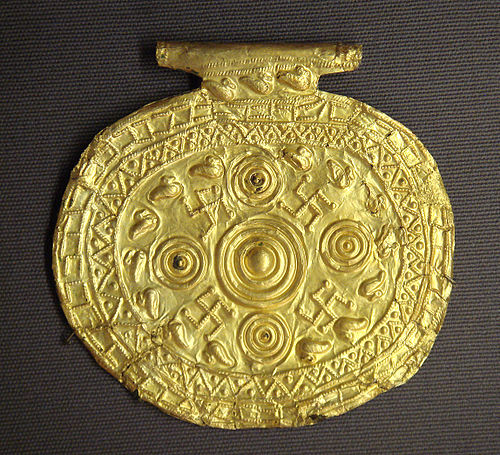
A 2019 genetic study published in the journal Science analysed the DNA of 11 Iron Age samples from the areas around Rome, including for the first time the whole genome sequencing of some samples from Etruscan tombs, and concluded that Etruscans (900-600 BC) and the Latins (900-200 BC) were genetically similar. A 2021 genetic study published in the journal Science Advances analysed the DNA of 48 Iron Age individuals from Tuscany and Lazio and confirmed that the Etruscan individuals displayed the ancestral component Steppe in the same percentages as found in the previously analysed Iron Age Latins, and that the Etruscans' DNA completely lacks a signal of recent admixture with Anatolia or the Eastern Mediterranean, concluding that the Etruscans were autochthonous and they had a genetic profile similar to their Latin neighbours.
In the collective volume Etruscology published in 2017, British archeologist Phil Perkins provides an analysis of the state of DNA studies and writes that "none of the DNA studies to date conclusively prove that Etruscans were an intrusive population in Italy that originated in the Eastern Mediterranean or Anatolia" and "there are indications that the evidence of DNA can support the theory that Etruscan people are autochthonous in central Italy"
In his book A Short History of Humanity published in 2021, German geneticist Johannes Krause, co-director of the Max Planck Institute for Evolutionary Anthropology concluded that it is likely that the Etruscan language (as well as Basque, Paleo-Sardinian and Minoan) "developed on the continent in the course of the Neolithic Revolution".
Herodotus wrote, the Lydians say that the Etruscans came from Lydia in Asia Minor (i.e. Anatolia). Herodotus did not claim this himself. But he has been criticised for this reference in his Historiai by historians ever since. Geneticists now also reprove him.
The Etruscan Kings of Rome
The Etruscan kings of Rome ruled during the Roman Kingdom period, which spanned from the founding of Rome (traditionally 753 B.C.) to the establishment of the Roman Republic (510 BC). While early Roman history is often mixed with legend, the Etruscan influence on early Rome is widely accepted. No culture makes up a story of being ruled by earth bound foreigners.
There were three Etruscan kings, according to tradition:
Lucius Tarquinius Priscus (Tarquin the Elder): The fifth king of Rome, he is credited with draining the Roman Forum, constructing the Circus Maximus, and initiating the building of the Temple of Jupiter Optimus Maximus on the Capitoline Hill. He was of Greek and Etruscan descent.
Servius Tullius: The sixth king of Rome, he is famous for organising Roman society into centuries and tribes, reforms that laid the groundwork for the later republican army and electoral system. He also expanded the city's boundaries and built a new defensive wall.
Lucius Tarquinius Superbus (Tarquin the Proud): The seventh and last king of Rome, his reign is depicted as tyrannical. His expulsion, along with his family, led to the overthrow of the monarchy and the founding of the Roman Republic.
These kings brought advanced Etruscan engineering, architectural styles, religious practices, and political structures to early Rome, significantly shaping its development.
They built Rome from a squalid town nesting above the Tiber into a large city with major public works. Damastes of the Greek city Sigeum in Anatolia, in the fifth century B.C. made the first known literary reference to Rome. A reconstruction of his reference is: After the fall of Troy, Aeneas came to Italy, and the Trojans founded a city that became associated with Rome.
It is intriguing the legend of the Roman lineage to Aeneas and Troy goes back at least as far as the fifth century B.C. in Greek literature, only a few decades after the fall of the Tarquins. It is also intriguing the claimed emigration of the Etruscans to Italy is from Anatolia, the homeland of Troy.
The lack of Anatolian genetic data in Tuscany has perhaps a Roman genocidal explanation. The Etruscan ruling class were exterminated or lost as a discrete population and so vanished from history. A unique exception might have been the Caesar family in Rome. They lost their Etruscan Royal heritage and by the first century B.C. , their descendants were reduced to living as Patricians in a middle class suburb instead of on the Palatine hill. Their budget might have compelled the family to employ a Gaul Gnipho instead of a Greek to be the tutor of their son, Caius Julius Caesar. Caius had day dreams of conquering with sadistic cruelty his tutor's Gallic homeland and one day becoming the next Etruscan King of Rome? Their Etruscan ancestry the family kept to themselves but privately they boasted they were descended from Aeneas who emigrated with his clan from Troy, eventually to Italy and there founded the city of Alba Longa? The founding city that is likely referred to by Damastes. An outcast Royal son, reared metaphorically as a wolf boy, abandoned Alba Longa to establish on the Palatine hill a bandit gang who plagued the peaceful folk of Latium for their supplies and their women? His bandit name was Romulus, little Rumon of Rumon, the Etruscan name for the Tiber. Like Little Augie Pisano, a mid twentieth century American gangster with a family origin from an Italian village. I imagine Romulus was a diminutive gangster who got control over his gang by treacherously murdering his older twin Remus.
Caesar has the etymology of hairy. Did an Eastern Mediterranean hairiness mark the Caesar family from the Indo European Roman Patricians? Julius Caesar hid his baldness by a combover and a Senate awarded laurel wreath. Did the hairy imagines (ancestral masks) of his Senatorial ancestors shame him?
Roman history loathed the Tarquins as cruel tyrants who made their Roman subjects akin to slave and destitute labour while they made Rome a gleaming "modern" city. I am reminded of the hated Mr Park the dictator of South Korea who kept his people semi slaves and destitute while he built the modern nation of South Korea. In 1988, South Korea startled the world by successfully staging the Summer Olympic games. Mr Park is remembered now for the public deposing of his President daughter and the South Korean movie, Parasite.
The Rape of Lucretia that in Roman Tradition Invented the Republic
While Roman soldiers were laying siege to the city of Ardea, a group of young noblemen—including the king’s son, Sextus Tarquinius, and Lucretia’s husband, Tarquinius Collatinus—fell into a heated debate about whose wife was the most virtuous. To settle the bet, they rode back to Rome in the dead of night to catch their wives unawares.
While the other noblewomen were found enjoying luxurious banquets, Lucretia was discovered late at night spinning wool with her maids, completely dedicated to her domestic duties. Collatinus won the wager, but Lucretia’s beauty and legendary purity sparked a dangerous fixation in the prince, Sextus Tarquinius.
A few nights later, Sextus returned to Collatinus's house alone. As a member of the royal family and a kinsman, he was treated with hospitality and given a guest room. In the middle of the night, he broke into Lucretia’s chambers with a drawn sword.
When she refused his advances even under the threat of death, Sextus made a more devastating threat. He claimed he would kill her, kill a male slave, strip them both naked, and leave their bodies together in her bed. He would then tell her family that he had caught her in a shameful act of adultery and executed them on the spot. To protect her family’s honour from a permanent, fabricated stain, Lucretia submitted.
The next morning, Sextus fled back to the military camp. Lucretia immediately sent for her father and her husband, asking them to bring trusted friends—including Lucius Junius Brutus.
Dressed in mourning clothes, she revealed the assault. Though the men swore to avenge her and assured her that her soul was innocent, Lucretia refused to pardon herself from the cultural consequences of the act. Declaring that no unchaste woman should ever use her as an example to escape shame, she drew a concealed dagger and stabbed herself to the heart.
Lucretia’s suicide transformed a private crime into a public catalyst. Lucius Junius Brutus drew the bloody dagger from her breast and swore a solemn oath to avenge her death and drive the tyrannical Tarquins out of Rome forever..

Lucius Brutus
Lucius Junius Brutus (c. 545. – 509 B.C.) is the towering, mytho-historical founder of the Roman Republic. To the Romans, he was the ultimate embodiment of virtus (manly virtue) and libertas (freedom)—the man who broke the chains of monarchy and established the system of checks and balances that defined Roman governance for nearly five centuries.
While his life is heavily wrapped in legendary lore by later historians like Livy and Plutarch, his biography serves as the foundational moral blueprint for the Roman character.
Tarquin’s reign was a bloody autocracy. Paranoid of any potential rivals, the king systematically executed Romans.
To survive, Lucius adopted a brilliant psychological defence mechanism: he feigned severe intellectual disability. He allowed himself to be treated as a court pet, a half-wit who could be mocked and ignored. This performance earned him the cognomen Brutus (meaning "the dullard" or "the stupid"). Tarquin left him alive because he viewed him as entirely harmless, even letting him accompany the royal princes on trips.
At that moment of Lucretia's suicide, Brutus dropped his idiot persona entirely. He pulled the bloody dagger from Lucretia's chest, held it aloft before the horrified household, and swore a sacred oath:
"By this blood—most pure before the outrage of a king's son—I swear... that I will pursue Tarquin the Proud, his wicked wife, and all his children, with fire and sword... and never will I suffer them or any other to reign in Rome."
Brutus had Lucretia's body carried into the Roman Forum. His sudden transformation from a mute simpleton into an eloquent, fiery orator galvanised the citizens. The populace voted to exile the royal family forever and strip the king of his command.
With the monarchy abolished, Brutus set out to ensure power could never again be concentrated in the hands of one man. He co-engineered a radical new system of governance:
The kingly power was split between two elected magistrates called Praetors fifty years later, changed to Consuls, who served for a term of just one year and held veto power over one another. The one‑year terms were to prevent long-term domination. The military command was shared between the Consuls.
Brutus and Tarquinus Collatinus (Lucretia's widower) were elected by the citizens as Rome's first Praetors.
This was Rome’s first major check-and-balance mechanism.Brutus forced the Roman people to swear a collective, ancestral oath that they would never again allow a king to rule over Rome—an oath so sacred that "Rex" (King) became the foulest political slur in the Roman language.
The Development Of The Roman Republic After The Expulsion Of King Tarquin
The Roman Republic developed rapidly and deliberately after the expulsion of King Tarquin transforming Rome from a monarchy into a complex, aristocratic republic built on shared power, annual magistracies, and institutional checks. The shift was triggered by the revolt following the rape of Lucretia, which ignited aristocratic anger and popular outrage, leading to Tarquin’s removal.
The Roman oath, never again to tolerate a King, was both symbolic and constitutional: Kingship was eliminated entirely, and no ruler as Rex ever again reigned in Rome.
Expansion and Empowerment of the Senate
The Senate, originally an advisory council of patrician elders, became the backbone of the new system. After Tarquin’s expulsion:
It was expanded from 100 to 300 members, incorporating new elites.
It gained control over finance, foreign policy, and legislation, becoming the stabilising force of the Republic.
Senators held lifelong positions, providing continuity in a system where magistrates changed annually.
Foundational Laws
Publius Valerius Publicola (Collatinus’s replacement) passed laws strengthening the Republic:
Laws protecting citizens from arbitrary power.
Measures increasing transparency and public accountability. These reforms helped stabilise the new government and win plebeian support.
Popular Assemblies and Citizen Participation
Although the early Republic was aristocratic, it did include:
Assemblies of citizens who voted on laws and elected magistrates.
A gradual increase in Plebeian political influence over time.
Primary power, however, remained with the Patrician elite.
The Class Conflicts
The early Republic was dominated by Patricians, which led to centuries of struggle with the Plebeians:
When the Plebeians Did a Walk Out in 494 B.C.
The Patrician Menenius said a parable to the decamped Plebeians on The Sacred Mount a few miles from Rome.
"The Senate was the belly — performing unseen but vital work.
The Plebeians were the limbs — powerful, essential, but weakened without the Senate’s functions.
The Roman state was a living body, and it could not survive divided."
The fable softened the Plebeians’ anger. They agreed to negotiate. And from that negotiation came the Tribunes of the Plebs, the office that protected Plebeian rights for centuries. A Tribune could any time give a veto (I forbid) that blocked a Senatorial or a Magistrate's degree.
This became one of the foundational metaphors of Western political theory — the idea of the body politic, where society is an organism and each class or office is an organ with a necessary role.
The Twelve Tables of Rome

Rome in the mid‑5th century B.C. was locked in the Struggle of the Orders: Plebeians demanded protection from Patrician arbitrariness. Before the Tables:
Law was unwritten and interpreted by patrician priests (pontifices).
Magistrates could impose penalties inconsistently.
Plebeians had no reliable knowledge of procedures or rights.
Pressure from Plebeians led to the creation of a special commission, the Decemviri Legibus Scribundis, (The Ten Lawgivers) tasked with drafting a public, fixed legal code.
An Imaginative Reconstruction
It is early 450 B.C.. The first ten tables have been publicly read, debated, and grudgingly accepted. But Rome demands more. Gaps remain, contradictions linger, and the Plebeians insist on further clarification.
A new board of Decemviri is appointed — but Appius Claudius, through political manoeuvring, remains at its head.
The first commission felt like a constitutional workshop. The second feels like a regime.
Appius sits at the centre, not merely presiding but commanding. The other nine watch him carefully.
A scroll lies open before Appius. He taps it once, decisively.
Appius: We must preserve the dignity of the orders. Write: No marriage shall occur between Patrician and Plebeian.
A stunned silence.
Herminius: Appius… this was not in the Greek models. Nor in our customs. It will inflame the commons.
Appius: Law is not written to flatter the commons. It is written to preserve Rome.”
Rabuleius: Such a ban implies impurity. Are we prepared to declare half the city unfit for alliance?
Appius: We are prepared to declare that Rome shall not be ruled by mixed blood.
The phrase hangs in the air — brutal, aristocratic, unmistakably political. The scribe hesitates, stylus hovering.
Appius: Write it.
The stylus scratches across the wax. Outside, Plebeians wait for news.
As the drafting continues, the commission members begin to understand: Appius is using the second round of legislation to reassert Patrician dominance and to consolidate his own power..
The first ten tables were a concession. Tables XI and XII are a correction.
The final table is a miscellany: clarifications, procedural fixes, and religious alignments. But Appius uses it to insert subtle but potent rules.
Appius: Add: If a magistrate renders judgment contrary to the written law, he shall be liable.
Herminius nods : This seems fair.
Appius: And: No private agreements shall override public law.
Rabuleius : That will invalidate half the city’s customary arrangements.”
Appius : Then half the city will learn to obey.
The scribe writes.
Herminius stands.
Herminius: Appius, this commission was created to complete the law, not to reshape Rome in your image.”
Appius: Rome is my image.
Herminius sits.
The wax drafts are finished. The Decemviri step outside. The crowd is larger than before — Plebeians, artisans, farmers, even some Patricians curious about the additions.
The scribe reads aloud the new provisions. When he reaches the ban on intermarriage, a wave of murmurs rolls through the crowd — shock, anger, disbelief.
Pleibeian woman: You write laws to bind us, not protect us!
Appius steps forward.
Appius: “Rome is strongest when each part knows its place.”
The crowd roars — not in approval.
But the Decemviri do not flinch. The tablets will be cast in bronze. The law will stand.
For now.
As the second commission disperses, Herminius whispers to Rabuleius:
Herminius : He means to rule beyond his term.
Rabuleius nods.
Rabuleius: And Rome will not tolerate it.
The Forum at sunrise — the bronze tablets unveiled
The Decemviri stand on a raised platform. Behind them, the Twelve Tables, newly cast in bronze, gleam in the early light. Crowds press forward: Plebeians, artisans, freedmen, even Patricians curious to see how much of their privilege has been preserved.
A herald raises his staff.
herald: Romans, hear the laws that shall govern all!
The crowd hushes. Even the birds seem to pause.
As the herald recites the rules for summons and court appearance, Plebeians nod. This is what they fought for: predictability.
A cobbler whispers to his neighbour:
cobbler: At last we know what they can demand of us.
A Patrician behind him mutters:
Patrician: And what we can demand of them.
For a moment, both orders feel the equilibrium of written law.
The herald reads the harsh provisions: confinement for unpaid debts, fixed days of imprisonment.
A farmer clenches his fists.
Farmer: Still chains. Still bondage.
Plebeian elder: Yes. But now chains with limits. Before, they could keep you forever.
The crowd murmurs — not approval, but recognition.
When the herald proclaims the paterfamilias’ authority, no one reacts.
Table VII — injury and compensation
Blacksmith: “Good. If a man breaks my arm, he pays. No more begging magistrates.
This table wins genuine approval.
Then Table XI is read — the ban on intermarriage
The herald’s voice echoes across the Forum:
Herald: No marriage shall occur between Patrician and Plebeian.
A wave of shock rolls through the crowd.
Plebeian woman: Who are they to tell us whom we may love?
Patrician youth: It is for the dignity of the orders.
She spits at the ground.
Plebeian woman : It is for the dignity of Appius Claudius.
The crowd erupts — anger, disbelief, betrayal. The Decemviri stand rigid, their faces masks of authority.
Table XII — the tightening of control
The herald reads the final provisions: magistrates bound strictly to written law, private agreements subordinated to public law.
Merchant: They mean to rule every corner of our lives.
Senator : They mean to rule beyond their term.
The crowd senses it too. The Twelve Tables are not just law — they are a political weapon.
When the reading ends, the Forum is a storm of voices. Some Plebeians cheer:We have law! We have rights! Others shout: The Decemviri have gone too far! Patricians whisper among themselves: Appius is dangerous.
But beneath the noise, something deeper settles over Rome: A sense that the city has crossed a threshold. That written law has changed the relationship between ruler and ruled. That Rome is now a place where power must justify itself in words, not merely in custom.
Plebeian elder: Bronze remembers. And Rome will remember this day.
Rome under the Decemviri — the atmosphere of a quiet tyranny
Plebeian Elder: We asked for law. We got masters.
Even Patricians whisper uneasily. Rome has no tradition of single‑board rule. The Decemviri’s continued power feels unnatural, un‑Roman.
The turning point: the case of Verginia.
Verginia: a young Plebeian woman, walks through the Forum with her father, Lucius Verginius, a respected centurion. Appius Claudius sees her — and desires her.
He concocts a legal claim: a client of his asserts Verginia is a slave, born of his household, wrongfully held by Verginius.
Appius presides over the case himself. The crowd gathers. They know what is happening.
Verginius arrives from the camp, breathless, sword still at his side. He pleads his case. The crowd supports him.
Appius raises his hand.
Appius: She is not your daughter. She is the claimant’s property.
A gasp. Outrage. The crowd surges.
Verginius looks at his daughter — terrified, trapped.
He whispers:
Verginius: My child… this is the only way you remain free.
He draws his sword and kills her. The Forum erupts.
Plebeian: Down wih the Decemviri tyranny!
Plebeian: Back to the Sacred Mount!
The cry echoes across the city.
Plebeians march to the Sacred Mount as in generations before.
Artisan: We will not return until the Decemviri resign!
The Senate panics. Rome cannot function without its Plebeians. Grain distribution halts. Military readiness collapses. The city feels hollow.
The Senate confronts Appius
In the Curia, senators gather — Patricians who once supported Appius now turn on him.
Senator : You have broken Rome’s customs. You have broken Rome’s peace.
Appius: I preserved order.
Senator: You preserved yourself.
The Senate votes: the Decemviri must resign.
One by one, the Decemviri step down — some quietly, some fleeing Rome. Only Appius resists. He is arrested.
Crowd: Justice for Verginia!
Appius, once the most powerful man in Rome, now sits alone in a dark cell. He hears the chants and knows his fate. Tradition says he killed himself before trial. Other accounts say he was executed. Rome does not mourn him.
The Plebeians return from the Sacred Mount. The Senate restores the Tribunate, the right of appeal, and the Magistracies.
Herald: The Decemviri are abolished. Rome is free.
The crowd cheers — not wildly, but with the deep, relieved roar of a city reclaiming its identity.
Verginius, grieving but dignified, is embraced by the people. His daughter becomes a symbol of liberty — a reminder that law must serve justice, not power.
Verginius returns from the Sacred Mount with the Plebeians. He walks through the Forum where he killed his daughter. People part around him — not out of fear, but reverence mixed with unease.
Artisan: That is the man who freed Rome.
Plebeian elder: That is the man who killed his child.
The Senate summons him
The Curia is quiet when Verginius enters. Senators rise — even Patricians who once supported Appius. The presiding Consul speaks:
Consul: Lucius Verginius, Rome owes you its liberty.
Verginius: Rome owes my daughter her freedom.
The senators bow their heads. .They simply acknowledge him.
In the days that follow, Plebeians gather outside his home.
Verginius: I did what I had to do. I will not make a career of it.
The crowd falls silent. They understand: he will not be a political symbol. He will be a father who acted, not a man seeking office.
Verginius asks to be reassigned to his legion. The Senate agrees immediately — they know Rome needs him, and they know he needs distance.
In the camp, soldiers greet him with respect, but not celebration. Legionaries understand grim necessity better than civilians.
In the years that follow, Verginius becomes a quiet legend. Not a hero. Not a martyr. Something more Roman: a man who acted decisively when the state failed.
Children learn his story alongside the Twelve Tables. Plebeians invoke his name when arguing for rights. Even Patricians cite him as proof that tyranny provokes virtue.
But Verginius himself never returns to politics. He serves in the army, retires to a modest farm, and avoids public life.
Verginius : I gave Rome liberty once. Let others keep it.
Verginius dies quietly, surrounded by comrades and family. Rome honours him with a simple inscription:
Lucius Verginius — defender of liberty.
But in private, Plebeians say a different line: He freed Rome by freeing his daughter.
Roman Dictatorships

A Roman dictator was an extraordinary magistrate of the Roman Republic who held supreme but temporary power during emergencies. The role evolved dramatically over time—from a tightly constrained crisis office to the near-autocratic rule of Sulla and Julius Caesar.
A dictator was appointed only in moments of crisis—military threats, civil disorder, or urgent religious duties. He held imperium maius ( authority above all other magistrates). His powers were broad but strictly limited to a mandate and traditionally lasted no more than six months.
His Nomination was by a Consul, usually after Senate consultation.
Early dictators were appointed to solve a crisis and step down immediately. The most famous example is Lucius Cincinnatus, appointed in 458 B.C., who defeated the Aequi and resigned back to ploughing his farm after just 16 days, becoming a symbol of civic virtue.
After the Second Punic War (218–201 B.C), Rome’s expanding military and political systems made the dictatorship less practical. The office fell into disuse for over a century.
In the 1st century B.C., the dictatorship was radically revived.
Plautus (c. 254 -184 B.C.)
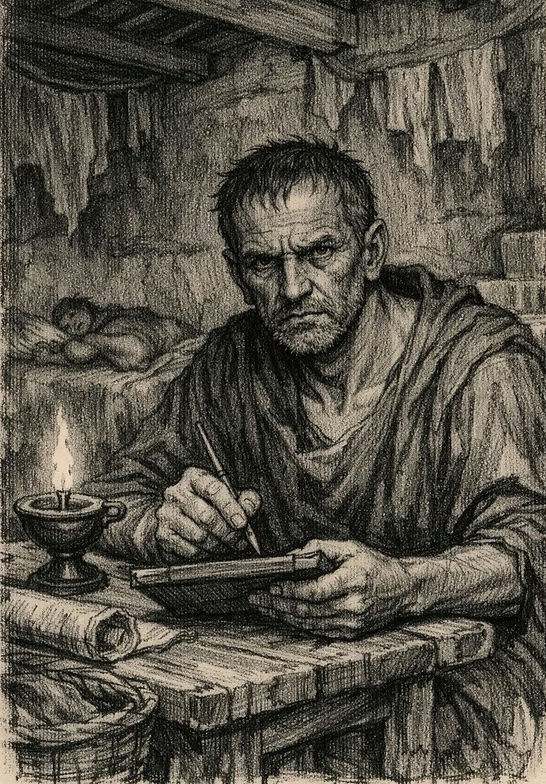
Plautus (Titus Maccius Plautus) was the most influential comic playwright of the Roman Republic, whose exuberant, joke‑packed adaptations of Greek New Comedy became the earliest fully surviving works of Latin literature. His plays shaped Western comedy from Shakespeare to Molière.
Born in northern -central Italy, Plautus likely began in theatre as a stagehand or actor, later turning to writing after failed business ventures. He may have been a slave.
Plautus adapted Greek New Comedy) but transformed it with:
broad physical humour
rapid-fire wordplay
expanded stock characters (parasites, clever slaves, cooks)
musical passages far more frequent than in Greek originals
exculpatory jokes reminding audiences they’re watching a play set in Greece.
Plautus pioneered alliteration, puns, riddles, and comic monologues, often sacrificing tight plot for immediate comic effect.
His comedies often show slaves outwitting masters, parasites manipulating the wealthy, and young lovers triumphing over obstacles — a humorous leveling of Roman social hierarchy.
Twenty one Plautus plays are extant. They include:
Menaechmi — mistaken-identity twins; source for Shakespeare’s Comedy of Errors
Plautus established the fabula palliata, Roman plays in Greek dress, which became the Republic’s dominant comic form.
His plots, characters, and comic devices shaped theatre farce from Elizabethan to modern farce.
Plautus’ Latin is a treasure trove — lively, idiomatic, and full of archaic forms.
An Imaginative Reconstruction
A cramped backstage office near the Forum. Scrolls everywhere. A half‑collapsed mask of Maccus (clown) on the shelf.
Plautus (flat-footed) : mid‑forties, still wearing the dust of the stage, bursts in clutching a wax tablet and a rolled script.
Producer : older, cynical, counting coins.
Plautus : Master, I’ve brought it — the new comedy. Menaechmi. Twins, confusion, wives, parasites — the whole Greek chest of tricks polished till it shines.
Producer ( doesn’t look up) Greek tricks again? The audience is tired of hack Greek leftovers. Every hack in Rome is staging twins, mistaken identities, lost children. If I see one more Menaechmi, I’ll burn down the theatre.
Plautus : Ah, but that’s why I’ve improved it. I’ve seasoned the Greek stew with Atellan farce — real Roman spice. Maccus, Bucco, the whole gang. Broad laughs, quick beats, jokes that land even when the plot doesn’t.
Producer : (squinting at him). Greek comedy is polite. Atellan is a tavern comedy. You think you can stitch them together without the seams showing?
Plautus : I can. I’ve played every fool on the stage — I know what makes the crowd roar. Let this hack play give me the bones; I’ll give them flesh. Roman flesh. Loud, rude, and alive.
Producer : (sighs, takes the script reluctantly) I’ll read it tonight. No promises. If it’s the same old Greek broth, I’ll toss it in the Tiber.
Plautus bows, hopeful, and exits.
The Producer sits in his tenement room, by lamplight, flipping through the script. He mutters.
Producer : Plautus… Plautus… always pushing, always performing. He’s outdated. The city wants refinement now — not actors who perform like they’re still juggling on street corners.
He tosses the scroll aside.
Producer : It’s time to sell him. Rome has outgrown his kind.
He blows out the lamp.
Morning — The producer’s office. The shutters are half‑open; dust floats in the sunlight. The Producer sits hunched over a pile of accounts, pretending to be busy.
Plautus : strides in, cheerful but with a nervous edge.
Plautus : Well? You’ve read it, haven’t you?
Menaechmi :. The twins, the wife, the parasite — all sharpened, tightened, and seasoned with a little Roman mischief.
Producer : (doesn’t look up).I skimmed it.
Plautus : Skimmed? You can’t skim Menaechmi! You’ll miss half the jokes.
Producer : (sighs, finally looks at him) Plautus… you’re still writing like you’re on the street stage. Big gestures, loud jokes, actors mugging at the crowd. Rome wants refinement now. Smooth Greek manners. Not… whatever you do.
Plautus : Refinement? The crowd doesn’t want refinement. They want laughter. They want Bucco tripping over his own sandals. They want Maccus stealing sausages. They want life — not Greek etiquette lessons.
Producer : (leaning back, steepling fingers) And yet the wealthy patrons pay for etiquette. They want their sons to hear Greek morals, not your tavern‑born chaos.
Plautus : (steps closer, voice tightening) Chaos is Roman. We’re a city of noise, markets, soldiers, debt collectors, drunk poets. Why pretend we’re Athens?
Producer : Athens has all those things too. But Greek theatre sells in Italy
A long silence. Plautus studies him — the evasive eyes, the stiff posture.
Plautus : You didn’t like it.
Producer : I didn’t say that.
Plautus : You didn’t need to.
He snatches the scroll from the desk.
Plautus : I’ve given you something new. Greek bones, Roman flesh. You could have a hit. But you’re afraid of anything that isn’t already approved by the Senate of Boredom.
Producer : ( stands, suddenly stern) Watch your tongue. You’re an actor, Plautus. A servile voice. Don’t forget that. (Smiles thinly)
Plautus exits
Producer : He’s stubborn and wrong for the new season. (softly) It’s time to get rid of him. Before he drags the whole theatre back into the mud.
He returns to his accounts, but his hand trembles slightly.
Next morning — the producer’s office. Plautus is halfway down the corridor when the Producer calls out.
Producer : Plautus. Wait.
Plautus stops, turns slowly, wary.
Plautus : You’ve more to say?
Producter : Yes. Curse you. Sit.
Plautus remains standing.
Producer : Fine, stand then. Listen. I read more of your play last night. Not all — I’m not a martyr — but enough. And… it’s risky. Very risky.
Plautus : Risky is good.
Producer : Risky is dangerous. Don’t interrupt. (he gestures with the scroll) If I stage this, the theatre might close next season. The crowd might laugh themselves sick and tear the benches apart in great spirits. Or they might walk out muttering that I’ve lost my mind.
Plautus : They’ll stay. They’ll roar.
Producer : Maybe. But if I don’t stage it… (he sighs, defeated) Then the theatre will close anyway. Not tomorrow, but soon. A slow death. Polite Greek comedies, polite applause, polite boredom. We’ll fade away like an old mural.
Plautus studies him, surprised by the honesty.
Producer : We’re actors, Plautus. Not public officials. If we lose, only we go down. The audience? They’ll survive. They’ll riot for fun or leave in high spirits, telling their friends they saw a disaster. (he shrugs) Either way, they get a story. We get the ruin.
Plautus : And yet you’re choosing the risk.
Producer : (grumbling) I’m choosing the only chance left. Your chaos might save us. Or kill us faster. (he thrusts the scroll at Plautus) Rewrite the second act. The Atellan bits — make them sharper. If we’re going to gamble, we gamble loudly.
Plautus takes the scroll, eyes bright.
Plautus : You won’t regret this.
Producer : I already do. Now get out before I change my mind again.
Plautus exits, in a hurry.
Producer : He’ll be the death of me. Or the resurrection. Jupiter help us.
Producer’s office — moments later. Plautus is still holding the scroll. The producer paces, agitated, as if arguing with invisible colleagues.
Producer : Listen, Plautus. I need you to understand something. (he points at the script like it’s a dangerous animal) If this decision were made by a committee — any committee — your play wouldn’t survive until lunch.
Plautus : Lunch?
Producer : They’d throw it out with derision before the bread was even cut. (he mimics high pitched, high falutin voices) “Too loud!” “Too Atellan!” “Too risky!” “Too clownish!” They’d shred it, burn it, and then congratulate themselves for protecting the dignity of Roman theatre.
Plautus : But there is no committee.
Producer : Exactly. There is only fool me.
He drops into his chair, rubbing his forehead.
Producer : I’m the one idiot who thinks — maybe — just maybe — this lunatic mixture of Greek twins and Roman buffoons might wake the audience up. (he gestures helplessly) I’m the only one reckless enough to gamble the whole season on you.
Plautus : You won’t regret it.
Producer : I already do. (leans forward, voice low) But here’s the truth: if we play it safe, the theatre dies slowly. If we stage your chaos, it might die quickly. (he shrugs) Either way, death is coming. But at least your version has noise, laughter, maybe even glory.
The Producer sits back, staring at the door.
Producer : The committee would sit at a table with an elaborate chart — columns for “Greek dignity,” “moral uplift,” “acceptable laughter,” “unacceptable laughter,” “Atellan contamination,” “Plautine danger.” (he snorts) Your play wouldn’t survive the first column.
Plautus : Which column is that?
Producer : Does this offend the delicate sensibilities of men who haven’t laughed since Romulus died?”
Plautus bursts out laughing.
Producer : They’d throw your script away not after debate, before the bread was cut. With derision. With those awful high‑pitched voices squeaking, “Next item!”
Plautus : But there is no committee.
Producer : (throws up his hands) There is only fool me. I’m the one idiot who thinks your chaos might save us — or kill us faster. But at least it’s a choice with blood in it.
One more thing. As it’s your play — your chaos, your gamble — I’m giving you the lead.
Plautus blinks.
Plautus : The lead?
Producer : Yes. The part of Menaechmus Sosicles — the twin who actually knows what’s happening. (he smirks) Or thinks he does. Perfect for you.
Plautus : You trust me with the lead role?
Producer : No. I don’t trust you at all. But if this madness works, it will work because you drive it. And if it fails — well — then I know exactly whom to blame.
Plautus raises an eyebrow.
Plautus : Blame is cheap. What about reward?
PRODUCER : If the play succeeds — truly succeeds — I’ll give you manumission. You’ll be a freedman. And not just that — you’ll have a partnership in the theatre. A share. A voice. A future.
Plautus stares, stunned.
Plautus : You’d do that?
Producer : Grudgingly. And only if the gods smile. (leans in) But if it fails — if the audience boos, riots, or leaves in great spirits telling everyone they saw a catastrophe — then I will sell you at the market as damaged goods.
Plautus : Damaged?
Producer : A playwright who ruined a season is damaged. An actor who led the disaster is doubly damaged. And a man who convinced me to gamble everything is damaged beyond repair.
Plautus laughs — (a reckless, delighted laugh) : So either I rise with the play… or fall with it.
Producer : Exactly. (he points at him sharply) No committee would approve this. Those high‑pitched voices would squeal and toss your script out before lunch. But there is only fool me. And I’m giving you the chance — and the rope.
Plautus : I’ll take it.
Producer : You’re the lead now. If we’re going to gamble, we gamble loudly.
Plautus bows and exits in a hurry..
Producer : Manumission or the market… Jupiter, what have I done?
Premiere Opening at the Ludi Romani (Roman games)
The crowd quiets as the first twin enters. He looks around, confused, muttering lines that Plautus rewrote only that morning. The audience leans in — the confusion is sharper, stranger, more human than they expected.
A few chuckles. A few whispers. But mostly: attention. Then the second twin steps out. The moment freezes. The crowd sees two identical masked men — one bewildered, one wary — and for a heartbeat Rome forgets to breathe.
The twins stare at each other. The crowd stares at them. The city stares at itself.
Menaechmus Soicles (Plautus) : (Now the serious Plautus) By the immortal Gods, I plead for your help, where on earth do these strangers come from who are accusing me?
The crowd erupts.
Laughter, shouting, applause — the release of tension hits like a wave. People slap their thighs, grab their neighbours, howl at the absurdity of it all.
The Producer (offstage turns to a stagehand) : He did it. He actually did it.
The stagehand nods, eyes wide.
Stagehand: They’re laughing… but they’re thinking too.
The producer swallows hard.
Producer : They see Rome and themselves as twins. Life will never be the same. Slaves will see Plautus' plays and make a slave Republic.
As the actors continue, the crowd roars with delight — but every so often, a spectator falls quiet, frowning, as if the comedy has shown them something they didn’t expect.
Cato The Elder : The Cabbage King (234- 149 B.C. )
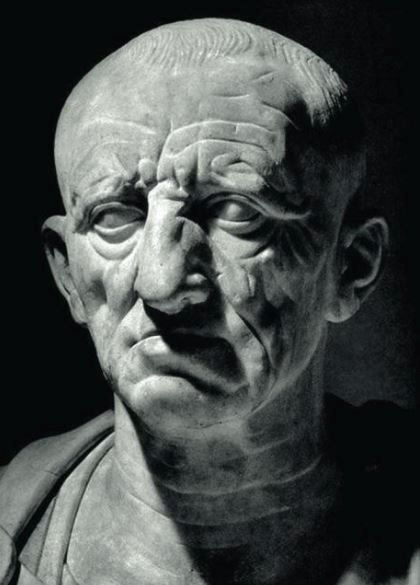
Cato the Elder’s literary works revolve around two major texts: De Agri Cultura and Origines. Together they form the foundation of early Latin prose and reveal Cato’s political, moral, and cultural agenda.
De Agri Cultura (On Agriculture)
The oldest surviving work of Latin prose, written as a practical manual for Roman farmers.
A farmer’s notebook, written in a direct, forceful, and simple style.
Ancient critics praised its vigorous clarity. Modern scholarship sees it as part of Cato’s self‑fashioning as the ideal Roman farmer and moral exemplar.
Agricultural instructions: vineyard management, estate organisation, slave labor, crop care.
Farming is praised as the most virtuous and productive Roman occupation, superior to commerce and usury.
Fourteen culinary recipes and methods for making Roman wines.
Traditional agricultural religious rites
Promotes frugality, efficiency, and domestic self‑sufficiency, aligning with Cato’s moral conservatism.
Serves as a cultural manifesto: Roman identity rooted in rural labor, simplicity, and ancestral virtue.
Influenced Roman agricultural writers and even eighteenth century– nineteenth century British agriculture.
Five decades ago, I resolved to adopt Cato's recommendation of a daily diet of cabbage or an alternate green. My chronic colds and influenza have almost vanished. Cato at times descended to dietary mumbo jumbo. But he intuitively understood life endowing (vitamins) properties in nutrition.
Cato pioneered farming from a traditional craft into a system of labour efficiency, and commodification of labour and produce. He anticipated modern factory management. Henry Ford reputedly said. "History is bunk." But in business management, he was a soul mate of Cato.
Origines (Origins)
A mostly lost seven‑book history of Rome which is the first example of Latin historical prose. It reinforced Cato’s vision of Roman virtue, contrasting ancestral simplicity with contemporary decadence. It acted as a counter‑Hellenistic project: history written in Latin, rejecting Greek historiographical models. It positioned Cato as both guardian of tradition and innovator of Roman prose.
Cato invented Latin prose genres: agricultural manual and national history. His literature was moral propaganda, shaping elite identity and public memory.
The Punic Curse
During a Senate debate about Carthage’s growing prosperity after the Second Carthaginian war, Cato returned from an embassy to Africa carrying a bunch of fresh, ripe grapes.
He held them up before the Senate and said : These grapes were picked only a few days ago- look how fresh they still are. Carthage is so close, so fertile, so wealthy, so dangerous.
Historians traditionally attribute Cato's obsessive paranoia to strategic and moral dangers. One should also attribute it to Cato's Ross Perot's intuition.
Cato used the grapes to argue that Carthage must be destroyed now, before it became strong again. This fear-driven politics is what Classical moralists say corrupted Rome after Carthage fell:
The grapes dramatised Cato's belief that Rome stayed virtuous only when threatened. The moralists said, by destroying Carthage. in 146 B. C, Cato removed the very threat he said Rome needed. This came to be called The Punic Curse.
The Senate was persuaded. Cato’s grapes helped tip Rome toward the Third Punic War—toward annihilation, not diplomacy.
Terence c.190 - 160 B.C. )
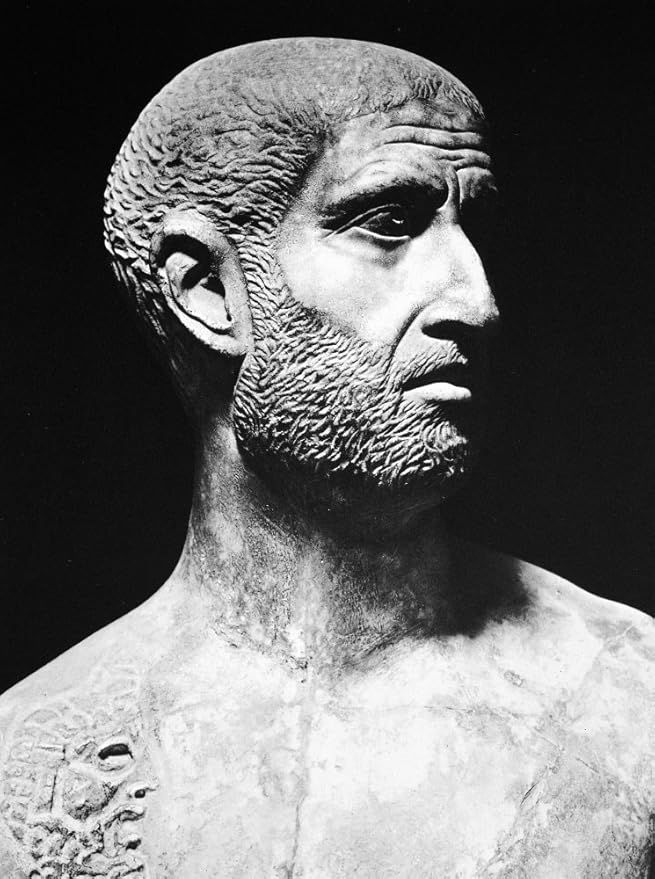
Terence was the most eloquent and second most influential playwright of the Roman Republic — an African‑born former slave whose six surviving comedies have shaped European drama for over two millennia.
Born in Carthage, Terence was brought to Rome as a slave, educated, and freed by the senator Terentius Lucanus.
His cognomen Afer (African) most likely reveals he was a Berber.
He entered Rome’s literary world through elite circles (often associated with Scipio Aemilianus), producing comedies for the major public festivals between 166 and 160 B.C. All six of his plays survive.
An Imaginative Reconstruction of The Young Playwright and his Patrons.
Rome, 167 B.C. — a private room in Lucanus’ villa
The lamps are low, the shutters half‑closed against the afternoon glare. Terence sits on a stool, a wax tablet balanced on his knee. He is a freedman amanuensis for Lucanus. He is slender, dark‑eyed, still carrying the Berber accent. Scipio Aemilianus stands opposite him, arms folded, studying him with the curiosity he reserves for unusual minds.
Scipio : You said you were born in Carthage. That is not a common origin for a Roman playwright.
Terence : I am not yet a playwright, sir. Only a freedman who writes in his spare hours. But yes — Carthage. The lower quarter near the harbours. I remember the smell of cedar and brine.
Scipio’s expression sharpens. Terence noticed it.
Terence : You think of Carthage as an enemy. I think of it as a childhood. Both can be true.
Lucanus entered quietly, scrolls under his arm.
Lucanus : He speaks plainly, Scipio. It is one of the reasons I freed him. The boy has a mind that cuts through pretence.
Scipio nodded, still watching Terence.
Scipio : And you write a play — Andria, you called it?
Terence : It is set in Athens but is in its soul Carthage. A story of identity, sir. A girl believed foreign who is not foreign. A young man torn between duty and affection. It is… a way of remembering what is lost.
He hesitates.
Terence : A way of preserving Carthage without naming it.
Lucanus’ eyes narrowed — not in suspicion, but in calculation.
Lucanus : You told me once you missed your home. I did not realise you were turning that longing into drama.
Terence : I have no other way to keep Carthage alive. Rome does not care for the memories of slaves.
Scipio’s gaze softened — just slightly.
Scipio : Memories are dangerous things. They can outlive cities.
Terence looks up at him, surprised by the gentleness in the remark.
Lucanus steps closer, lowering his voice.
Lucanus : Terence… you know things about Carthage. Its streets, its customs, its people. (A pause) Such knowledge may matter in years to come.
Scipio glances at Lucanus — a silent exchange between Patricians who understood the weight of future wars.
Scipio : You have talent, Terence. And clarity. Bring your script next time. (He smiles faintly.) If I like it, I will see it staged at the next festival — under your own name.
Terence freezes, tablet in hand. For a moment he looks like the boy he had been — frightened, hopeful, astonished.
Terence : Under my name?
Scipio : Yes. Rome should hear your voice. Even if it was born in Carthage.
Lucanus places a hand on Terence’s shoulder — not possessive, but proud.
Lucanus : Come again, boy. Bring the play. And bring more of your memories. (He glances at Scipio.) They may prove useful to Rome — and to you.
Terence bows his head, clutching the tablet as if it were a lifeline.
Rome, A year later.. — Scipio Aemiliaanus' garden portico at dusk
The garden is quiet except for the trickle of water from a small fountain. Scipio Aemilianus sits beside it, hands clasped behind his back, staring at the fading sky. Terence approaches slowly, unsure whether he has been summoned for praise or interrogation.
Scipio does not turn.
Scipio : You write about foreignness with… precision. Not as an observer. As someone who has lived inside it.
Terence stops a few paces behind him.
Terence : I write what I know, sir.
Scipio finally faces him. His expression is unreadable — neither warm nor cold, but searching.
Scipio : Tell me what you remember of Carthage.
Terence hesitate. He has spoken of Carthage only in fragments — never fully, never to a man who might one day command armies against it.
Terence : I remember the harbour. The smell of cedar. The cranes creaking in the wind. (He swallows.) I remember my mother’s voice.
Scipio watches him closely.
Scipio : And the people?
Terence : Berbers. Punic merchants. Sailors from everywhere. Carthage is not one thing. It is… many things woven together. Romans think of Carthage only as fraudsters and child ritual sacrifices. That is only part of the truth. Carthage is the world like Alexandria. The harbour area I grew up in were mostly Greek merchants. That is why I can write plays set in Greek cities.
Scipio : nods slowly, as if confirming something he suspects.
Scipio : You speak of it without bitterness.
Terence : Bitterness is for men who still have a home. I have only memory.
Scipio’s gaze softens — but only for a moment.
Scipio : Memory can be weapon or wound. Rome will soon need to understand Carthage. Not just its walls and harbours — its people, its mind.
Terence stiffens.
Terence : Sir… I am not a spy.
Scipio raises a hand.
Scipio : I did not say you were. But you know Carthage in a way no Roman does. And you write with clarity. That combination is rare.
Terence looks down at his hands.
Terence : I write to remember, not to harm.
Scipio studies him for a long moment.
Scipio : Cato at his every oration says, "Carthage must be destroyed". I will oppose this as long as I can. Fate will determine this. Destruction is not understanding. And I need understanding.
Terence’s voice trembles.
Terence : What do you want from me?
Scipio looks toward the darkening sky.
Scipio : Truth. Not the truth of soldiers or merchants. The truth of someone who loved the city before he lost it.
Terence felt the weight of the request.
Terence : If I speak, I betray Carthage. If I stay silent, I betray Rome. I do not know how to be loyal to both.
Scipio turns back to him, his voice low.
Scipio : Be loyal to the truth. Rome needs men who see clearly. Even if they come from Carthage.
Terence closes his eyes, fighting the ache in his chest.
Terence : I will tell you what I remember. But not what to do with it.
Scipio nods.
Scipio : That is enough. For now.
The fountain trickles. The sky darkens. Two men — one destined to destroy Carthage, one destined to preserve it in words — stood together in uneasy silence.
True History : Later writers saw the destruction of Carthage as the turning point where Rome embraced:
fear
aggression
expansion
moral absolutism
These traits tore the Republic apart for the next century until Augustus imposed peace in 27 B.C. The Roman Empire tempered these traits but never lost them.
The Moral Prophesy at the final fall of Carthage
Scipio Aemilianus’ words at the fall of Carthage in 146 B.C. are one of the most famous moments of Roman historical memory.
Scipio stood amid the burning ruins of Carthage, wept, quoted Homer on the fall of Troy, and then told the Greek historian eyewitness, Polybius, he feared Rome would one day suffer the same fate.
Polybius records that as Carthage burned, Scipio recited lines from Homer’s Iliad about the destruction of Troy. He clutched Polybus's hand and lamented. "It is glorious... but I have a dread foreboding that someday the same doom will be pronounced upon my own country."
This moment became a cornerstone of Roman moral reflection: the conqueror realising that Rome’s victory carried the seed of its own future decline.
Scipio’s words understood :
the hubris of total destruction.
the moral danger of eliminating Rome’s greatest rival.
the historical pattern that great cities fall when they reach their height
Scipio might have taken heart that in 2026, Rome has never been destroyed.
Later Roman writers treated this moment as the beginning of Rome’s internal corruption.
The Gracchi Brothers

What Tiberius Gracchus saw in the Italian countryside in 137 B.C. a decade after the fall of Carthage.
Tiberius Gracchus’ famous journey through the Italian countryside is one of the most emotionally charged moments in Roman history. Ancient sources describe it as the turning point—the moment when a young Aristocrat realised the Republic was rotting from within. What he saw became the seed of his reform movement.
An imaginative re-construction
The sun is low over the hills of Etruria. Dust rises behind the hooves of Tiberius Gracchus’ horse as he travels between Roman military postings, carrying out his duties as Quaestor. He is twenty‑something, educated, idealistic, and still believes Rome is what his mother taught him it was: a Republic of citizen‑farmers.
But the road begins to tell a different story.
Fields stretch for miles, but they are silent. No smoke rises from cottage hearths. No children run between olive trees. No farmers call out greetings.
The land is worked—yes—but not by citizens.
Dozens of men, chained together, move in slow, exhausted rhythm under the watch of armed overseers. They harvest grain, prune vines, dig irrigation trenches. Their backs are bent, their eyes hollow.
These are not Roman citizens. They will never serve in Rome’s legions. They will never vote. They will never own land.
Tiberius reins in his horse and watches them. The overseer does not greet him. The slaves do not look up.
He sees abandoned farms. Stone houses collapsed. Roof beams rotted. Doors hanging open. The small plots once tended by free families are swallowed by massive estates—latifundia—owned by senators and worked by slaves. The countryside is not dying. It is being emptied.
A limping man, still wearing a fragment of his old military belt, begs for work at the gate of a great estate. The overseer waves him away. The estate has no need for free labor.
Tiberius recognises the insignia on the man’s belt. They fought in the same war.
He feels shame.
No small farmers means no citizen‑soldiers. No citizen‑soldiers means no Republic. Rome’s strength—its legions—was built on men who owned land and had a stake in the state.
But the land is gone. Taken. Consolidated. Devoured by the wealthy.
Ancient writers describe this moment as the catalyst for his reforms: He feared the collapse of Rome’s military manpower, which depended on land‑owning citizens.
His vision became the moral and legal justification for his land reform programme. It shaped his agrarian reform law, the Lex Sempronia Agraria, which tried to restore land to citizens and revive the Republic’s foundations.
True History: How modern Archaeology Differs from the Ancient Historians
Modern archaeology shows a more complex, region‑specific, and less catastrophic picture of the Italian countryside than the dramatic crisis described in ancient sources about Tiberius. The traditional story—of vast slave plantations replacing free farmers everywhere is not fully supported by the archaeological record.
Archaeology suggests the decline in free citizens reported in Roman censuses was not necessarily caused by rural depopulation, but by citizens evading conscription, not disappearing from the land.
Large slave‑run estates existed, but archaeology shows regional variation:
Some areas did have large estates. Other regions retained dense networks of small farms well into the late Republic. The countryside was not uniformly transformed.
In southern Italy, small farms were abandoned due to the Second Punic War, not because of latifundia expansion.
Archaeology supports some elements of the crisis:
Wage labor scarcity
High grain prices
Migration to cities
Rural poverty
But these pressures were not uniform across Italy.
Ancient authors wrote with political and moral agendas. They portrayed a dramatic collapse of the free farming class to justify reform or condemn it.
Modern archaeology shows ancient writers relied on political rhetoric and moralising narratives.
Marius the Founder (157-86 B.C. of the Roman Professional Army)

Caius Marius was a Roman general and statesman who:
Served seven consulships, more than any other Roman in history.
He rose from equites (middle class) origins as a homo novus (new man) in an Italian village. His military genius rose him through the ranks, winning favours from Patricians and eventually entry into the Senate.
He became famous for victories in the Jugurthine War, Cimbrian War, and Teutonic War.
His rivalry with Sulla triggered civil conflict that helped destabilise the Republic.
Marius instituted Rome’s first truly professional army beginning in 107 B.C., during his first Consulship, and continued shaping it through his later consulships (104–100 B.C.). The reasons were both practical military necessity and deep social change in the Republic.
Marius professionalized the army because Rome could no longer raise enough property‑owning citizen soldiers, and because ongoing wars (Jugurthine War, Cimbrian invasions) demanded larger, long‑serving, better‑trained forces. He solved this by recruiting the landless poor, providing state‑funded equipment, and creating a long‑term volunteer force.
107 B.C. — Marius elected consul; opened enlistment to the capite censi (landless poor).
104–100 B.C. — As consul five years in a row, he continued reorganising and standardising the legions.
Rome’s traditional army relied on citizens who owned enough property to equip themselves. By the late 2nd century B.C., small farms were disappearing under long overseas campaigns and economic pressure. Rome did not have enough eligible men to fight King Jugurtha of Numidia and the invading Cimbri and Teutones German tribes.
Campaigns in North Africa, Spain, and northern Italy required soldiers who could serve for years, not just a season. A volunteer force solved this.
The landless poor saw military service as a source of income, not just civic duty. This made recruitment easier and created a stable, motivated force.
By supplying weapons and armour, Marius removed the wealth barrier and created standardised legions.
Soldier loyalty shifted to generals, not the State — a key cause of later civil wars.
His political comeback in 87 B.C. led to a violent purge of opponents before his death shortly after his seventh consulship.
Sulla invaded Italy and made a blood bath. Then he retired to his villa to write his memoirs.
Modern scholarship notes that the idea of a single, perfectly unified “Marian Reform package” is partly a later scholarly construction. Some changes attributed to Marius actually developed gradually during later conflicts.
Julius Caesar 100 -44 B.C.

As Julius Caesar was crossing the Alps and passing by a small impoverished village, his companions joked if there were any there contending for positions and whether there was any strife among their leaders for honour. Julius answered seriously. 'I had rather be the first man here, than the second man in Rome. That was recorded by Plutarch. That was in 61 B.C. when Julius was traveling to Spain to take up the position of Propraetor (Governor). He was thirty something, a political rock star but loaded with debt and not yet Imperator (holder of a triumph) nor Consul ( chief Magistrate).
Julius may well have pondered at the Alpine village, not just his own renown but the glorious history of Rome since the legendary foundation of the Republic almost seven hundred before. Each generation in Rome had principes, the first men of Rome. They succeeded the Roman Kings by holding a succession of the chief offices. Julius furiously contended to be the next princeps after Pompey and Crassus. Thirteen years later, both Crassus and Pompey would be dead by violent means. The princeps and dictator perpetuuo ( dictator in perpetuity) Julius would follow them by assassination four years later.
Two hundred and forty three years before the founding of the Republic, Romulus had in tradition founded the village of Rome on the Palatine hill. Julius might have been thinking about that small impoverished village and its founder King Romulus. By Romulus' and his bandits' warrior prowess, that small village had looted and kidnapped women to dominate the Palatine and its neighbouring hills. If he Julius were the first man at that Alpine village, might not he be Romulus? The Sabine God Quirinus had been merged with Romulus, after his mysterious disappearance or murder by his Senate (elders) in a storm. Julius Proculus, a Senator, made Romulus a God from a vision. Romulus in the vision had announced that the Gods willed Rome to be the capital of the world. That legend of Rome as the future capital of the world started after the defeat of Carthage in the Second Punic war in 201 B.C. , in an epic poem by the Latin poet Ennius. Until then, the Romans perceived their wars to be defensive or regional. In most years in Spring time, the season of the war God Mars, the men of Rome marched out to fight their neighbours for land, loot and rapine. That had also the necessity of culling the overly reckless and weak men. Rome was no more nor less expansionist than any one else in the Mediterranean lands. But after 201 B.C., the Romans believed their military prowess and favour from the Gods would make them the world rulers. Now no Kingdom nor tribe was safe from Roman predations in the Mediterranean lands and eventually the entire Roman known world.
Julius Caesar was of the same clan as Julius Proculus who had proclaimed Romulus to be the patron God of Rome. The prestige of the Julians went deep into Roman history. King Tulius Hostilius had levelled Rome's mother city Alba Longa. He exiled the population to Rome to double its size. The Alba Longa Julian chief clan were enrolled into the Senate. The Julian's nobility extended even deeper. They claimed their clan founder was Iulus, also known as Ascanius, the son of the Trojan hero Aeneas. Aeneas was the son of the Goddess Venus in Greek mythology, Aphrodite.
From his Trojan and Alba Longa Royal lineage, Julius' high ambitions may in his youthful dreams have extended to Kingship of Rome. His Julian family were the Caesars. Caesar means hairy. Nicknames of notable Romans became the family names of their descendants. Did a notably hairy Alba Longan start the Caesar family name? Like Harry (hairy). Were they descended directly from the Lydian Kings that Herodotus mentioned? Crossing to Italy as a Royal branch, their native hairiness drew the mirth of the native Italians? Julius would often have studied the imagines maiorum (ancestral death plaster masks in the atrium (reception hall) of his family villa. They likely reached back to Aeneas. Aeneas and his descendants' imagines might have been follically endowed to demonstrate their Trojan Royal lineage. Julius Caesar himself went bald. Was he stricken by some baldness disease? His baldness was a source of striking embarrassment to Julius as if it deviated from his Caesar family appearance?
His baldness was a disfigurement which troubled him greatly, since he found that it was often the subject of the gibes of his detractors. And so, of all the honours decreed him by the senate and people, there was none which he accepted or used more gladly than the right of wearing a laurel crown at all times : Seutonius: De Vita Caesarum. (Lives of the Caesars).
Caius' family villa was in a middle class suburb in Rome. The Patricians' villas were on the Palatine hill. His childhood tutor was a former Gallic slave who had been exposed at birth in Gaul, and later owned by the Patrician family, Antonius.
An Imaginative Reconstruction of the Youth of Caius Julius Caesar.
When Caius was an infant, he caught a severe viral infection. His family feared for his life. He recovered his health but all his hair fell out. From a rumbustious infancy, he became a solitary, pale and weedy boy. He rarely played with the other Patrician children. His favourite past time was to read books and day dream about Greek and Roman history.
One evening, Caius Julius Caesar (his father) sighed heavily and when his mother and the slaves had left supper, he says : We are from the noblest Roman family. Even the Claudians are novi homines compared to us Julii and especially our Caesar family. We are descended from Aeneas and so from the Goddess Venus. We hide that Royalty by saying our first Caesar ancestor was cut out (exsecare) of his mother's belly. If the Brutus family find that out they would have us all regicded. The Brutus family were Plebeian spies for the Etruscan Tarquins. When the Senate overthrew the Tarquins, they ingratiated themselves to the Senate and with bribes became the regicide Brutus Patricians. We Romans never publicly admit Aeneas was an Etruscan. And so we are hairy Etruscans. Behold my curls and evening shadow, and the beards and curls of our imagines. But you dear boy have lost all your hair from your illness. You will have to go through all your life being daily mocked as the hairy hairless. and the prey of pederasts. Only If you are elected Princeps, (the first man), will the public mockery cease. Our family is poor. Your grandfather incurred debts, and I had to sell our Palatine villa and move us down to a neighbourhood of money grasping merchants. We can only afford a Gallic freedman to be your tutor. He is a superb grammarian and rhetor but he is despised as a barbarian. I have incurred huge debts to win the Princeps, As a Praetor (Judge) and ProPraetor (Governor) I amassed a fortune. But I spent it to win the Consulship and failed the election. Physicians tell me I have the crab disease and may die before you put on the toga virilis. Such is my fate allotted to me by the Gods. My future will have to live in you.
No, no, no : cried the boy and he hugs his father.
Caius Caesar caresses his son.
Caius Caesar : When I have departed to Hades, whatever that means, you will be the master of this household and incur my debts. Your wonderful mother will follow your orders.
Caius spent a fretful night. His safe cosy world had collapsed. He had never had much to do with his father. The foci of his father were the Senate House and the intrigues with his fellow Patricians. His father was embarrassed to be outdoors with his family. He wore the curule rank, purple striped toga praetexta but had to rub shoulders with men who commanded ships and trades. What was now to become of the Caesar family fortune? His fretfulness grew when he recalled his father's odd words."Whatever that means." Caius had not doubted the stories of the Greek Gods , both Greek and Roman. They occupied a cosmic reality outside the mundane. If they were just stories to entertain children, where were his father, mother and he himself going to go after their mortality ended? Just vanish from even memory like the bruti (the animals)? That reminded him how could the Bruti family rise to exalted Patricians from Plebeians. Plebeians, or at least their most degraded sort, were little higher than foxes and bears. Were the Plebeian Bruti that sort? And even lower as Etruscan spies?
Caius heard a banging and shout on his bedroom door. That was his tutor Marcus Gnipho. Caius heart sunk again. He was due for another lesson and likely another sore stick beating. Gnipho had said to him the day before : I have only a few weeks left before you put on the toga virilis. Then I will not be able to beat you anymore. I will have to make up for lost time.
Caius had prayed to Romulus that Gnipho was merely making one of his cruel jokes. Caius was dreading his adult initiation on his sixteenth birthday. He would have to remove his toga praetexta and put on his all white toga virilis. He dreaded that his household would start laughing at his boy figure under his tunic. He knew his father had delayed his initiation after the Liberalia festival in his desperate hope he would show manhood. Indeed at the ceremony, his mother, his two sisters, family friends, his dresser Uncle Consularis Lucius, and all the slaves had stifled their laughter.
What do you know about the Gracchi brothers? : asked Gnipho.
Caius and Gnipho were in the house study. Gnipho sat on a cathedra (a high backed chair). Caius sat below him on a stool with his wax table and style on his lap. On a table beside Gnipho were his scrolls, inkpots, reed pens, and his ferula (cane). After a honey bread roll, eggs, cheese and a fig, the dawn lesson continued until siesta.
The Gracchi brothers tried to destroy the Republic and replace the Tarquins : said Caius as a reflex reply.
Gnipho surprisingly smiled. Then his face and voice went sombre : Your father came into my room after supper last night and told me before you put on the toga virilis, he may die. He said you and your mother know this already.
Caius nodded. He fought back his tears.
Gnipho continued : He told me to give you this lesson because he is too ashamed to give it himself. When you go out into the world as a man and inheritor of his household, you will be in an utterly corrupt and violent world. After the Hannibal war, the Patricians have become totally corrupted by wealth and greed. They fight not for Rome's welfare. They fight to enrich and glorify themselves, their families and their retainers. The lessons I have given you about Roman history were mostly rubbish until the Hannibal war. Since then complete rubbish. The Romans, since the Hannibal war, believe King Romulus promised them in a dream that Rome would never be conquered and one day will rule the world. Two years after Brutus established the Republic, the Etruscan King of Clusium Lars Porsena conquered Rome and only withdrew after payment of tribute. In that disastrous war, we only celebrate the one eyed soldier, Horatio. Rome has made much progress since then but fate will end her as it ends every Empire.
Caius blanched and wondered if in his private grief for his father, Gnipho had lost his senses.
Gnipho continued in a quiet tone : The Gracchi brothers tried to reform Rome from within to its former state. They were murdered by the Patricians for their pains. Since then, Rome has been ruled by armed gangs led by the Patricians, masquerading as Roman law. Rome has proven it cannot be reformed from within. It only survives now because Romans obey their religious vows out of superstitious fear. Your father tried to restore the Caesar Royal lineage, not as Royalty, that would be a death sentence, but as dictator perpetuo. When Rome is restored as much a Republic as Roman nature would allow, he planned to retire like Cincinnatus. He prays to the household spirits for you to take his place as the great restorer even the new Romulus of Rome.
Caius replied. The boys mock me for my hairless condition even though I am their leader in games.
Gnipho considered that : Your hairless condition will attract Eastern Potentates like flies to honey. In open sewer Rome. you have to take every advantage you have.
Caius was startled at his tutor's cynicism. He considered something that had bugged him for some years. Now he felt free to ask.
Caius : Did Jupiter really turn into a swan and rape Leda. And she laid Helen?
At yesterday's evening lesson, Gnipho would have reached for his ferula. Now he just smiled and quoted Euripides in his play Helen. "So they say." Then he spoke earnestly to Caius.
Gnipho : Keep the Roman virtues, they do not need the Gods. When like your poor father we die, we shall find out the divine truth. Great men like Romulus and Alexander are turned into Gods to save them from divine punishment. King Alexander destroyed Thebes, and a thousand thousands of barbarians like myself. King Romulus was a fratricidal bandit.
The dawn after his donning his toga virilis and his household humiliation, Caius played the trick on his tutor he had planned for several days. To celebrate his first manhood day, he had to declaim a passage from a major Roman event, He had started on Horatio's saving of Rome when even the Etruscan enemies cheered his swim across the Tiber. But now he doubted Horatio could do that in his armour, and suspected his heroic story was a myth to cover up the occupation of Rome by King Lars Porsena. Then a Roman story he had read years ago, caught his attention and desire for revenge at last on his cruel tutor.
Standing before Gnipho, he declaimed and concluded : Camillus had the school master stripped naked, his hands tied behind his back, and gave the boys rods with which to drive the traitor back into the city.
Caius was about to conclude. "The people of Falerii were so impressed by Camillus's sense of justice that they voluntarily surrendered to Rome, believing they could trust such an honourable enemy.
Cnipho seized his ferula. He savagely struck Caius across his legs and arms.
Gnipho : That is your punishment for disrespect for Rome's customs.
Gnipho screamed. His mother and his sisters ran into the study. Cnipho put away his torture instrument.
Gnipho : I am a freedman and citizen. You cannot lay a finger on me. Give me my wages, and I will leave your household now. You will either one day be made dictator perpetuo or be murdered and turned into a God, like Romulus, or all three..
Caius gave Cnipho his wage arrears and Gnipo departed the household never to return. When Gnipho and Caius encountered each other, they evaded their faces. Gnipho used his savings to set up his own household and a school study room. He became a famous teacher and author on rhetoric. Even Cicero was known to attend his lessons. But Caius recoiled at the mere thought of him, and never spoke publicly about him. When he was appointed as ProConsul of Cisalpine and Transalpine Gaul, he vented his boyhood fascination with Gnipho's stories about Druidic Gaul, and his genocidal hatred of the Gallic race.
True History: Caius as a Catamite
Caius as a youth about eighteen became the cup bearer of an Eastern Potenate, King Nicomedes of Bithynia. The term catamite is derived from Ganymede, the cup-bearer of Zeus. A Roman comedian saluted the alliance between Pompey and Caesar as Rex (King) Pompey and Regina (Queen ) Caesar.
An Imaginative Reconstruction of Caius Caesar's Dream The Night after he received his Toga Virilis
The atrium was quiet except for the faint trickle of water from the household fountain. The air smelled of incense and damp stone. Servants had withdrawn to the corners, leaving a long path of polished marble between the doorway and the man who waited at its end.
Caius stepped forward in his toga virilis. He moved carefully, aware of how the fabric hung on his still‑slender frame. He felt exposed, but he held his posture.
At the far end stood Caius Marius, old and ill, but still sharp-eyed. His gaze had fixed on Caesar the moment he entered the atrium.
Caesar bowed his head.
Caesar : I am your great‑nephew, Caius Caesar.
Marius’s lips curled into a dry, sardonic smile.
Marius: That I should be honoured.
He let the barracks humour linger.
He stepped closer, studying the boy. His eyes moved over Ciaius’ boy figure and the childish smoothness of his skin.
Marius: You still look a boy.
Caiusr : But I stand before you as a man today.
Marius nodded once, sharply.
Marius: Good. A man is not made by muscle or beard. Rome has had enough of men who look strong and think weakly.
He circled Caesar slowly, like a veteran inspecting a new recruit.
Marius: You carry yourself well, despite what the sickness stole. That matters more than appearance. Rome judges by presence, not by hair.
He stopped in front of Caesar.
Marius: Tell me, boy—do you know what it means to be a man in Rome today?
Caesar: To serve the Republic.
Marius snorted.
Marius: The Republic? He gestured toward the city beyond the doorway. The Republic is dying. I have fought for it, bled for it, been exiled for it. And now… His gaze sharpened.
Marius : Now I wonder who will inherit what remains.
Caius stood straighter.
Caius : I intend to honour our family.
A flicker of something—pride, perhaps—passed across Marius’s face.
Marius: Good. Honour the family. But remember this: (He leaned in, voice low. )
Marius : Rome rewards ambition, not obedience.
A coughing fit seized him; he steadied himself on a column. When he recovered, he waved Caius forward.
Marius: Go. Begin your life. And do not let the Senate tame you. They tried to tame me.
A thin smile.
Marius :They failed.
Caius bowed again.
As he turned to leave, Marius called out:
Marius : One day, Rome will need someone who refuses to bow. Perhaps that someone will be you—even if you do not yet look the part.
Caesar stepped into the sunlight, the words echoing behind him like a prophecy.
Pompey Magnus (The Great) 106 - 48 B.C.

Pompey’s Pirate War—also known as Pompey’s campaign against the pirates (67 B.C.)—was one of the most dramatic and efficient military operations of the late Roman Republic. It ended centuries of Mediterranean piracy in just three months, reshaped Roman naval power, and helped launch Pompey to unmatched political dominance.
Pompey was granted extraordinary powers under the Lex Gabinia to clear the Mediterranean of pirates. He used 500 ships, 120,000 infantry, and a divide‑and‑conquer strategy to crush pirate fleets from Spain to Cilicia in southern Asia Minor, capturing or destroying over 800 ships and 120 pirate bases.
By the mid first century B.C., piracy had become a geopolitical threat:
Pirates commanded over 1,000 ships, forming large fleets rather than small raiding bands.
They raided grain convoys, threatening Rome’s food supply.
They burned Ostia, Rome’s main port, in 68 B.C.
They kidnapped Roman magistrates and disrupted trade across the entire Mediterranean.
Rome’s earlier attempts to suppress piracy had failed to eliminate the problem.
The tribune Aulus Gabinius proposed the Lex Gabinia, granting Pompey:
Command over the entire Mediterranean and all land within 50 miles of the coast
Authority to raise 500 ships, 120,000 infantry, 5,000 cavalry
Control of the treasury and ability to appoint 25 legates (admirals)
A three‑year term (though he finished in months)
This was the most sweeping command ever given to a Rome before their Emperors.
Pompey divided the Mediterranean into thirteen zones, assigning commanders to each.
His forces cleared Spain, Sicily, Sardinia, and North Africa, securing Rome’s grain routes.
Pompey himself led operations through Greece and the Aegean, driving pirates eastward.
The remaining pirate fleets gathered in Cilicia, where Pompey launched a combined land‑sea offensive. Seventy one ships were captured, three hundred surrendered
Major strongholds were destroyed
Pompey’s reputation for clemency led thousands of pirates to surrender voluntarily.
Instead of executing the pirates, Pompey resettled them inland in depopulated towns, turning former raiders into farmers and taxpayers.
This policy was radical by Roman standards and helped stabilise Asia Minor.
The Mediterranean became mare nostrum (“our sea").
Trade and grain supply stabilised.
Pompey’s prestige soared, paving the way for his later command in the Third Mithridatic War.
The Third Mithridatic War (73–63 B.C.) was the final and decisive showdown between King Mithridates I of Pontus and Rome, ending with Rome’s complete domination of Asia Minor and the eastern Mediterranean. It is the war where Lucullus first shone, Pompey finished the job, and Mithridates—Rome’s most persistent eastern enemy—died in exile.
Pompey’s settlement reshaped the Near East:
Pontus was partially annexed into Roman Bithynia
Syria was annexed as a Roman province
Armenia was turned into a Roman client kingdom
Rome’s presence in Asia Minor became permanent, marking a major step toward the later Roman Empire.
Contrast of Caesar’s Gallic War with Pompey’s Eastern Clemency
The contrast reveals two opposite models of Roman imperialism. One produced cultural replacement; the other produced cultural integration.
Caesar’s campaign was brutal, expansionist, and transformative.
Modern historians describe parts of the Gallic War as genocidal because Caesar’s own Commentarii record:
Entire tribes annihilated
Mass enslavements
Deliberate destruction of political structures
Forced population movements
After the conquest:
Roman colonies were founded
Latin became the administrative and eventually everyday language
Roman law, religion, and urban planning replaced tribal systems
Gallic elites adopted Roman identity to survive politically
By the second century A.D., Gaul was one of the most thoroughly Romanised regions of the Empire.
This was replacement, not coexistence.
Pompey’s Eastern Settlement: Stability Through Respect for Local Cultures
He resettled surrendered pirates inland, turning them into farmers instead of executing them. This stabilised the Mediterranean without destroying communities.
Pompey did not attempt to Romanise the East:
Greek cities kept their laws, councils, and cultural institutions.
Indigenous kingdoms (Armenia, Judea, Nabatea) remained semi‑autonomous.
Local languages (Greek, Aramaic, Armenian) continued to flourish.
Hellenistic religion, philosophy, and education remained dominant.
Rome ruled the East through an unequal partnership, not replacement.
The eastern Mediterranean remained:
Greek-speaking
Urbanised
Philosophically and artistically vibrant
This continuity is one reason the Eastern Roman Empire (Byzantium) could later emerge from a deeply rooted Hellenistic world.
The East was already urban, literate, and politically complex
Rome needed its systems; it could not easily replace them.
2. Gaul was tribal and decentralised
Rome could impose its own structures more easily.
In Gaul: expansion, glory, land for veterans, and Caesar’s personal political survival.
In the East: stability, revenue, and alliances against Parthia.
Pompey’s clemency reduced resistance.
By avoiding mass slaughter, he created conditions for long-term cooperation.
Statues, shrines, and public honours were put up for Pompey in the eastern Mediterranean, especially in Greek cities. Pompey was the most honoured Roman in the Greek East before Caesar and Augustus. These honours were not random; they reflected how eastern communities understood Pompey: as a liberator, a restorer of order, and a protector of Greek civic life.
Greek cities set up statues, honorary inscriptions, and dedications praising Pompey as:
Sōtēr (Saviour)
Euergetēs (Benefactor)
Ktistēs (Founder)
These titles were normally reserved for Hellenistic Kings.
He was honoured by towns resettled with former pirates by:
founder cults
public statues
annual civic celebrations
Greek-speaking elites praised him for:
restoring order
ending public chaos
protecting city privileges
Pompey did not receive statues in Jerusalem — Jewish tradition forbade such imagery — but Josephus records that some Jewish factions viewed Pompey as a restorer of order after the Hasmonean civil war.
This was not a cult, but it shows that even non-Greek communities sometimes saw him as a stabilising figure.
The Gallic linguistic and cultural resistance to Roman Conquest
In early French and some regional dialects, the Latin month Julius (July) was replaced or altered because the name Julius was associated with Julius Caesar. In a few places, July was called “Second June” or “After June” in local speech.
Unlike Pompey in the East, Caesar did not receive:
founder cults
hero shrines
temples dedicated to him
annual festivals
voluntary civic worship
An Imaginative Reconstruction of a Policy Disagreement between Crassus and Pompey
In Pompey’s villa at Alba, late afternoon. The air is hot, the shutters half‑closed, and two of Rome’s most powerful men stand facing one another — Marcus Crassus, arms crossed and jaw tight, and Pompeius Magnus, calm but visibly irritated. A few attendants linger nervously at the edges, pretending not to listen.
Crassus steps forward first, voice sharp.
Crassus: You parade your weakness as if it were virtue, Pompey. I crushed Spartacus. I ended a rebellion that threatened Rome itself. I did what had to be done — extermination. No half‑measures.
Pompey : Most of the pirates were not born pirates. They were driven to it — dislocated by wars, ruined by Kings and our Republic, abandoned by the very States that should have protected them.
Crassus : Futue te (fuck you). A pirate is a pirate. They prey on Rome’s grain, Rome’s merchants, Rome’s allies. You think resettling them in Cilicia) will tame them? They will return to the sea now you are back in Italy. And their sons will learn the piracy from them.
Pompey : I destroyed their fleets. I destroyed their bases. I offered mercy only when they had no strength left to resist. And what did they choose? Not the sea — but farms, homes, families.
Crassus : You are naïve. Mercy is weakness. Rome survives because men like me do what must be done.
Pompey : Weakness? I pacified the entire Mediterranean in three months. Trade flows again. Cities prosper again. The East calls me Sōtēr — saviour. You think slaughter alone builds peace?
Crassus jabs a finger towards him : Peace built on pirates is no peace at all.
Pompey : Peace built on corpses is not peace either.”
The room goes still.
Pompey : The wars have shattered communities from Cilicia to Crete. Fishermen became raiders. Farmers became smugglers. I did not merely defeat them — I restored them. I turned enemies into taxpayers, raiders into citizens.
.
Crassus : Citizens? They are outlaws.
Pompey : They were victims of chaos. I ended the chaos. I gave them light at the end of the tunnel.
Pompey’s attendants glance at one another — the argument has reached its peak.
Pompey turns away, dismissing the confrontation with a wave of his hand.
Pompey : You boast of extermination, Crassus. I boast of restoration. Rome needs both strength and wisdom.
Crassus stands rigid, furious but silent.
Pompey leaves the room.
Cicero 106 - 43 B.C. : The Godfather of Humanism

Born in Arpinum, a town 100 km from Rome as was Marius, Cicero came from a wealthy equestrian family. He received elite training in:
Rhetoric
Philosophy
Roman law
He served briefly in the military, then began his legal career in 81 B.C. quickly gaining fame for fearless prosecutions of corruption.
Consul (63 B. C.)
His most famous moment was exposing Catiline’s attempted coup. The Senate hailed him pater patriae (father of the country).
But his approval of the conspirators’ summary execution — without trial — later exposed him to political retaliation.
Cicero fled Rome and lived in exile for 16 months, returning in 57 B.C. after a public campaign for his recall.
This exile is the event, the second- third century historian Dio Cassius imaginatively joined with Cicero’s later grief for his dead daughter. in his Rhomake Historia (Roman History)
During the Caesar–Pompey civil war, Cicero hesitantly sided with Pompey.
He was pardoned by Caesar after Pompey’s defeat
After Caesar’s assassination (44 B.C), Cicero became the Senate’s leading voice against Mark Antony, delivering the Philippics — fiery speeches urging resistance.
After Octavian and Antony reconciled, Cicero was placed on their hit lists. In 43 BC; his head and hands were displayed on the Rostra in the Forum.
An Imaginative Reconstruction of Cicero's Encounter with the Athenian Philosopher Philiscos as imaginatively told by Dio Cassius.
Cicero sits alone, worn by sorrow. His clothes are unkempt, his face hollow. He speaks as if to himself, yet loudly enough for any passerby to hear.
Cicero: Rome has cast me out. My enemies rejoice. My house is torn down, my honours stripped away. And now — the gods have taken my daughter. What remains for me? I taught men how to endure misfortune, yet misfortune has broken me. I spoke of virtue, yet virtue has abandoned me. I am undone.”
Philiscos enters quietly. He watches Cicero for a moment, then speaks.
Philiscos: Cicero, I have heard your words. You lament like one who has never studied philosophy, never counselled others, never stood in the Senate teaching men how to bear adversity. Is this the same Cicero who proclaimed that fortune is nothing, that virtue is everything?”
Cicero looks up, startled and ashamed.
Cicero: Do not judge me too harshly. My grief is great. My exile is unjust. My daughter—
Philiscos: I do not deny your suffering. But suffering does not excuse contradiction. You have lived as a teacher of self‑control. Now you live as a refutation of your own teachings.
Cicero : Philosophy is easy in calm weather. But when the storm comes, even the strongest ship groans. I am only a man.
Philiscos: Then speak as a man, not as a child. You have lost much — but not everything. Your mind remains. Your virtue remains, if you choose to reclaim it. Your grief is natural, but your collapse is not.
Philiscos: steps closer, his voice firm but compassionate.
Philiscos: Remember what you yourself have said: That grief is a wound of judgment, not of fate. That exile is a change of place, not a loss of dignity. That death is the common lot of all. If you believed these things when you taught them, believe them now. If you did not believe them, you should never have taught them.
Cicero lowers his head.
Cicero: You speak truth, though it cuts me. I have been inconsistent. I have let sorrow master me.
Philiscos: Then rise. Let your actions match your words. Let your philosophy be more than ornament. Let your grief be human, but your endurance be Roman.
Cicero stands slowly, breathing deeply.
Cicero: I will try.
Philiscs: Trying is the beginning of virtue.
Philiscos places a hand on Cicero’s shoulder. Cicero, steadier now, walks with him out of the room. The finale.
Cassius Dion was a Greek speaking Roman Senator from Nicea in Asia Minor. He was a product of Pompey's clemency. Yet in his Rhomake Historia, (Roman history) he glosses over Pompey and lauds Caesar. After his clemency in Asia, Pompey returned to Rome in triumph figuratively and literally. There was much public fear, Pompey would return with his battle hardened and loyal army. Instead, Pompey disbanded his army because the Senate promised they would fulfil his promises of land to his troops. Instead, the deceitful and corrupt Senate reneged. Julius Caesar would not make that mistake. He said at the end of his Gallic wars, he would disband his army if now de facto dictator Pompey would disband his. Pompey refused and his reputation as Rome benefactor was destroyed. He fled with his troops out of Italy to fight Caesar's armies. Without the legitimacy of Rome, he and his family became regarded and treated as outlaws and bandits.
Now their roles reversed.. Pompey became the exterminator of Caesar's allies, and Caesar the pardoner of his enemies. After the decapitation of Pompey, Caesar, under the humanism of Cicero, treated his enemies as if the civil war never happened. They returned to Rome as senior Magistrates under the benign dictatorship of Caesar. Caesar was betrayed and knifed to death by them in the Senate House, ostensibly because Caesar aimed to be Rex. Pompey exercised the same clemency to the pirates. But in their resettlement, he gave them agricultural tools. He did not return their ships and cutlasses.
Julius Caesar set up the Acta Diurna (Daily Gazette) during his first consulship in 59 BC.
Acta Diurna :
issued daily public postings of official acts.
required Magistrates to record Senatorial decrees.
created a public album (whitened board) in the Forum.
included the first Senate proceedings.
Caesar made government business publicly visible on a daily basis. Copies were sent to Governors and elites throughout the Empire.
The Acta Diurna included:
summaries of Senate debates
Magistrates’ decisions
legal outcomes
public announcements
births, marriages, deaths
gladiatorial results
economic notices (grain supply, treasury matters)
It was the world's first daily newspaper, and Caesar weaponised it..
Caesar as dictator introduced The Julian Calendar, invented in Alexandria.
His economic measures did not cancel debt. Instead they salvaged the Imperial economy by easing conditions for both lenders and debtors.
He rebuilt with Italian colonists the Roman destroyed cites of Carthage and Corinth. He preserved their ancient names but they were now Romanised cities.
He invented a "real history" coldly devoid of moralising out of his offical reports to the Senate about his Gallic campaigns and his civil war. In his reports, he was always God like and his enemies diabolical. Cicero praised this Commentarii. "They are naked, straightforward, and graceful, stripped of every ornament of style, as though of clothing.".
In 47 B.C. , Caesar sent a three word report to the Senate about his swift victory over the king of Pontus : Veni, vidi, vinci. He aimed to insult Pompey's conquests as against Eastern weaklings, as contrasted with his fierce Gallic and German enemies. The British Empire taught in its public schools his Commentarii. These school boys graduated educated or indoctrinated to conquer and rule over the world's biggest Empire.
Dio Cassius was of the Eastern Mediterranean culture as was the Hebrew author of the Book of Job, Near Eastern lamentation poetry, and Greek drama influenced both of them. Cassius was not likely to have read The Book Of Job. Cassius was Greek speaking and pagan. But the parallels between The Book of Job and the dialogue between Cicero and Philiscos are striking. However there is no wife to tell her side in the Cicero Philiscos dialogue. Classical philosophy has no females to bring it back to earth.
An Imaginative Reconstruction of the Encounter of Job with his Wife and Friends
Job sits outside his house on a low stone, staring at the ground. He look exhausted — not just tired, but worn down in a way that makes him seem smaller.. Everything he had built, everything he had loved, had collapsed in a single terrible sweep of misfortune.
His wife stands nearby, arms folded, watching him with a mixture of worry and frustration. She had cried until she couldn’t cry anymore.
Wife: Curse God and die. (In English Standard Version of Bible)
Job doesn't answer. He just breathes slowly, as if each breath hurts.
Three men approach from the road — Eliphaz, Bildad, and Zophar. They had heard about Job’s disaster and come to see him. When they reach him, they sit down without speaking. For a long time, nobody says anything. The silence feels heavy, like a fourth person sitting with them.
Eliphaz:: Job, you’ve helped a lot of people in your life. You’ve given advice, comfort, guidance. But now trouble has come to you, and you’re falling apart. You need to steady yourself.
Bildad : Look, things like this don’t happen for no reason. Think carefully. Search your life. There must be something behind all this.
Zophar : Job, you’re talking like you’re innocent. But nobody is innocent. Straighten yourself out. Fix what needs fixing. Then maybe things will turn around.
Job: I hear what you’re saying. But you don’t understand what this feels like. My grief is bigger than your explanations. My pain doesn’t fit into your theories. I’m trying to hold on, but everything hurts. I'm not giving up. But I don’t have answers. Not today.
The wind moves through the dry grass. The four of them sit together — not in agreement, not in comfort, but in the strange companionship that suffering forces on people.
An Imaginative Reconstruction of SMS Texts between New Zealand law makers Jami-Lee Ross and Sarah Dowie in 2019. The Final Text is Thought to be True.
Jami‑Lee Ross — 11:42 PM : I don’t know how to keep going. Everything feels ruined. I feel ruined.
Sarah Dowie — 11:43 PM : Jami… you can’t text me like this again.
Jami — 11:44 PM : I’m sorry. I just don’t see a way out. I feel like I’m drowning.
Sarah — 11:45 PM : You deserve to die. (a long pause)
Cato the Younger 95-46 B.C.
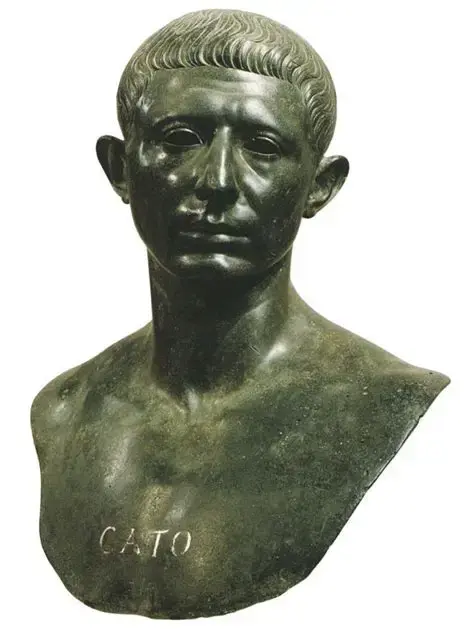
Cato the Younger is the deepest embodiment of late‑Republican Stoic virtue — rigid, incorruptible, politically obstructive, and ultimately tragic. He is the only recorded person who refused Caesar, refused compromise, and finally refused life itself, choosing suicide rather than live under a dictatorship of Caesar. Caesar was most annoyed. He said he wanted the pleasure of pardoning him
Cato (Marcus Porcius Cato) was a Senator, great‑grandson of Cato the Elder (the cabbage King). His orphaned childhood was marked by austerity, Stoic training, and a reputation for unyielding temperament.
Key traits:
Stoic discipline — walking everywhere on foot, shunning luxury, cultivating endurance.
Moral rigidity — incorruptible, inflexible, often obstructionist.
Political conservatism — champion of the Optimates (defenders of senatorial authority)
angering Caesar.
Cato’s relentless obstruction of Caesar, Pompey, and Crassus helped push them into forming the First Triumvirate. He opposed Caesar’s agrarian laws, blocked Pompeian commands, and became the moral voice of the senatorial elite.
When a thanksgiving was ordained for Caesar’s victory against Germanic tribes, Cato moved in the Senate that Caesar be surrendered to the enemy— because Caesar had violated a truce.
Civil War
Though he had opposed Pompey for years, Cato concluded that Pompey was the Republic’s only hope against Caesar. He joined Pompey, attempted to defend Sicily, then regrouped in Africa after Pompey's final defeat at Pharsalus.
After Caesar’s decisive victory in North Africa, Cato refused to surrender. He evacuated his followers, then committed suicide — an act seen by Romans as the ultimate Stoic assertion of freedom.
His death became a cultural battleground:
Cicero wrote a panegyric Cato.
Caesar responded with Anticato, attacking him.
Cato became a symbol of:
Republican virtue
Resistance to tyranny
Stoic moral purity
His life is often read as the final stand of the old Roman Patrician ideal — austere, uncompromising, and doomed.
Joseph Addison’s Cato: A Tragedy (1713) was performed for General Washington’s army in 1778, becoming a symbolic act of morale, political messaging, and classical identification. It dramatises the final days of Cato.
Rome's Republic in word and deed became the model for the founding fathers of America. Greece's Democracy and Rome's Republic rank as the political structures that almost all countries in the world claim to be.
Sallust 86 - 35 B.C

Sallust was the first great Latin historian whose works survive. He was a sharp, morally charged analyst of the late Roman Republic’s corruption and political decay. His major works are Bellum Catilinae (Catiline’s War) and Bellum Iugurthinum (The Jugurtha War).
Born in Sabine, Sallust rose as a novus homoHis political career was turbulent: tribune of the Plebeians in 52 BC, expelled from the Senate in 50 BC (likely for political reasons), then rescued by Julius Caesar, who gave him military commands and later the governorship of Africa Nova.
His experiences — street violence, factionalism, corruption, and the collapse of Republican norms — shaped his historical voice: compressed, bitter and moralising,
His style is concise, forceful, archaising — deliberately anti‑Ciceronian — and obsessed with the moral decline of Rome’s elite.
Sallust argued Rome’s moral collapse began after the fall of Carthage, when ambition and greed replaced civic virtue.
His works dissect how personal rivalries, bribery, and factionalism destroyed Republican governance.
An Imaginative Reconstruction
Scene: Caesar’s townhouse, a walking distance from the Forum, late evening. A lamp burns low. Caesar stands at a table covered with dispatches. Sallust enters, summoned — but already angry.
Caesar : You governed Africa Nova like a bandit chief. The complaints are endless. Theft, extortion, bribes. You’ve shamed me.
Sallust: (sharply) I shamed you? You began a civil war, Caesar. You crossed the Rubicon and tore the Republic in half.
Caesar : I crossed because I had to. My soldiers had land promises to defend. My family had glory to uphold. And the Senate expelled the tribunes — as they did to the Gracchi. I defended the rights of the people.
Sallust: (laughs bitterly) Rights? When a tribune vetoed your seizure of the treasury, you ordered the locked door broken open.
Caesar: That was necessity. You — you were just a low‑down thief in Africa. You lined your pockets. You preyed on provincials. I can look a Roman schoolboy in the eye and justify my actions. You cannot.
Sallust: (smiling thinly) A schoolboy? You decide what goes into Rome’s history, Caesar. You decide what the schoolboy reads. You decide which crimes become “necessity” and which become “corruption.”
Caesar: And you think that excuses you?
Sallust: No. It explains you.
A long silence. Caesar’s jaw tightens.
Caesar : You’re clever, Sallust. Too clever. You twist history like wax.
Sallust : History is wax, Caesar. You mould it. I write it. Between us, truth doesn’t stand a chance.
Caesar steps closer, voice low.
Caesar : Write what you want. But remember — I am still alive. And history obeys the living Caesar.
Sallust : (smiles) For now.
Continued in the blog, Rome Was Built In A Day Part Two


Comments