Rome Was Built In A day Part Two
Updated: 1 day ago

Augustus 63 B.C.-14 A.D.

Augustus and Livia: A Political Marriage That Became an Imperial Partnership
When Octavian met Livia Drusilla in 39 B.C, she was :
20 years old
Already married
Already a mother
From the ancient Claudian family.
Known for her intelligence, self‑possession, and severity of character.
Octavian was instantly drawn to her both physically and strategically.
He divorced Scribonia. Livia divorced Tiberius Nero. They married with shocking haste.
Rome gossiped. But Octavian didn’t seem to to care. He had found the one person whose mind matched his own.
However, an archive preserved an epistle from his rival Mark Antony justifying his sex with his Egyptian married wife Cleopatra by accusing Octavian of infidelity to Livia.
"Does it matter where or with whom you fuck?'
The Roman Imperial couple were:
Controlled
Private
Pious
Bound by shared ambition
Bound by shared trauma (both had lived through civil wars).
Livia and her baby future Emperor Tiberius had once hidden in a burning forest to escape her future husband's army.
Augustus
Emotionally cautious
Physically frail
Politically relentless
Needed stability and loyalty.
Livia
Emotionally disciplined
Intellectually sharp
Politically intuitive
Needed purpose and influence.
Livia shaped the empire through:
Counsel — Augustus trusted her judgment more than any advisor
Household discipline — she ran the imperial family like a political institution
Succession management — she navigated the dangerous question of who would rule after Octavian/Augustus. Rumours circulated she poisoned dynastic rivals to Tiberius. An accusation rejected by conventional history but confessed in Robert Graves' novel I Claudius .
Public image — she embodied Roman ideals of modesty, virtue, and stability
Networks — she maintained alliances with Rome's most prestigious and powerful families.
She was the Empire’s internal stabiliser.
Where Augustus built Rome’s external architecture, Livia built its internal one.

Octavian's Burgeoning Early Career
When Caesar was murdered in 44 B.C, Octavian was eighteen. He returned from his Grecian studies to Italy and discovered Caesar had adopted him in his will.
This changed everything.
He inherited :
Caesar’s name
Caesar’s fortune
Caesar’s unfinished political project
Caesar’s enemies.
Rome laughed at him at first. Then he started winning.
After Julius Caesar's death, Octavian had been addressed as Imperator Caesar. Imperator was his imperial military title. Caesar became his personal name after adoption as the son of Julius Caesar. Historians keep his old name Octavian so as not to confuse him with Julius Caesar.
Octavian formed the Second Triumvirate with Mark Antony and Lepidus. The First Triumvirate had been Pompey, Crassus and Caesar. Both were brutal de facto dictatorships.
Together, Octavian and Antony :
Destroyed Caesar’s assassins.
Divided the Roman world between them.
Purged enemies.
Raised armies and extorted fortunes.
The alliance collapsed. Antony drifted into the world of Cleopatra, and Octavian exploited this masterfully.
He framed the conflict not as civil war but as:
Rome versus Egypt
Discipline versus decadence.
Duty versus personal obsession.
The propaganda was devastating.
The final battle at Actium (31 BC) ended the Republic’s last great rivalry. Antony and Cleopatra died. Octavian became the unchallenged master of the Roman world.
The Secured Principate
After sixty years of civil wars which were implosions of Patrician led legions regularly changing sides, ravaging the Empire and initiating mass vendettas, the populations of the Empire settled down to an uneasy mass amnesia. Histories covering the thirteen years from Caesar's assassination 44 B.C. to the start of the Antony- Cleopatra war 31B.C. were not written. That last war was blamed on the bewitching of Cleopatra over Antony. Most of the enemies of Octavian received amnesty. Mark Antony and Cleopatra conveniently suicided. Octavian gave Antony an honourable funeral. Octavian however mercilessly hunted down the assassins of his adopted father, Julius Caesar. That was both a personal and a religious response. Their families were still allowed to honour them. Statues erected by cities outside Italy honouring Brutus and Cassius as liberators from a tyranny were allowed to stand. There was a statue of Marcus Brutus in Lugdunum (Lyon).. Augustus looked at it and said. "Marcus Brutus was good to Lugdunum."
In 27 B.C., Octavian “restored” the Republic to the Senate — and the Senate immediately voted him extraordinary powers.
They renamed him Augustus, meaning to magnify by divine favour. Augustus had planned to be renamed Romulus, He would be the founder of New Rome. He had restored the legendary hut of Romulus to visually tie Rome to her deepest roots. However the fates of Romulus and Julius Caesar determined him to choose Augustus. All Roman Emperors after Augustus were also titled Augustus.
Augustus kept Caesar to bind his Imperial prestige to his great uncle, Julius Caesar. All Roman Emperors made Caesar their personal name. Caesar survived into the twentieth century as Kaiser and Tsar.
Augustus was permanently endowed by the Senate with Rome's key powers. He held tribunicia potestas maior (supreme tribunician power) giving him the tribunes' immunity and veto over all official decrees. He took ownership of Egypt with its grain supply that Rome depended upon. The consulship continued, but under his Principate, it was increasingly filled by Suffecti (multiple pairs of consuls) each year, spreading prestige while real power remained with him. Romans still officially dated years by the first two Consuls' names. Imperial documents often also counted an Emperor's tribunician years and other titles.
Augustus divided the provinces into senatorial provinces and imperial provinces . The senatorial provinces were governed by Proconsuls (ex- Consuls and ex Praetors). Imperial provinces were militarised and governed by Legati Augusti Pro Praetore, (delegates of Augustus).
However, from the earliest days of the Principate, Augustus issued written and oral instructions to all provincial governors before their departure to their province and supplemented their pay from both public and his private funds. This made Augustus the coordinator of provincial governance despite the constitutional façade of shared authority.
All soldiers swore loyalty to Augustus and to Senatus Populusque Romanus (The Senate and the Roman people). Only Augustus could be saluted as Imperator Proconsulare Maius (Supreme Imperial Proconsul) and only Tiberius celebrated a triumph after 27 B.C. After Augustus, only Emperors and their family members celebrated triumphs with one exception in A.D. 47 after the conquest of Britain. All victories won by provincial commanders became officially attributed to the Emperor, ensuring that military prestige and political legitimacy were monopolised by the Emperor.
Augustus reformed the Acta Senatus (Senate minutes). He ended their public publication, and put them under strict imperial control. This transformed the Senate public records into a restricted archive serving the Principate. Access required permission from the Praefectus Urbae, (Augustus' appointed Mayor of Rome).
Augustus’ restructuring of the Senate — reducing its size, purging unworthy members, and redefining its role as at best an imperial advisory body — created an environment in which the Acta Senatus became a controlled constitutional instrument rather than a public political weapon.
Since Julius Caesar's first consulship, Senate proceedings were published in the Acta Diurna (Daily Gazette ) to reveal senatorial politics. Augustus banned this practice, removing Senate debates from public view.
Like Von Bismarck, he made law be perceived as formal and solemn, not a Plautine sausage making.
The second- third century Roman historian, Dio Cassius wrote in his Rhomaike Historia (Roman History ) : "The events occurring after this time, (the Principate), can not be recorded in the same manner as those of previous times. As a result much that never occurs is reported widely and much that happens beyond a doubt is unknown, and in the case of nearly every event a version gains currency that is different from the way it really happened."
This imperial structure lasted with few important changes until the Severan dynasty after A.D. 193. The Emperors with their militarised support could do almost anything. How far, depended on their morals, their caution and political circumstances. If it so humoured the Emperor, he might ask the Senate to issue a decree after he had consulted with senatorial leaders. Or he could simply give a verbal command. Until the Severan dynastry and later, no Emperor apparently ordered a crucifixion of a citizen in Italy except once in a civil war.
But the Emperor could anywhere order executions. However most Emperors, were mindful of assassinations and army revolts.
Augustus formalised the Republican Cohortes Praetoriae (Praetorian Guard) as an elite protective force for the Principate, while in Rome he created the Cohortes Urbanae (urban cohorts) as a paramilitary police, and the Vigiles (night watchmen and firefighters). Together, these forces were the hard edge of Augustan rule in Italy- security, order and when needed, intimidation.
Augustus' immunity as Tribunicia Potestas spared him from prosecution. However, he could not retire without incurring a very real risk of ruin to him and his family. Until the Emperor Diocletian's retirement in 305 A.D, no Emperor dared retire. By then, the Principate was the man, not his office.
Augustus' and Livia's political architecture aided by shrewd counsellors made them effective master and mistress of the Empire.
Augustus was an honorific title. In 27 B.C. , the Senate bestowed this title upon him to signify his elevated religious and political majesty, changing his formal public name to Imperator Caesar Divi Filius Augustus ( Emperor Caesar Augustus Son of the Divine ).
In the Republic "restoration" what was most publicly valued was the return to apparent normality. No one disputed Augustus was the ultimate arbiter. But since Sulla's tyranny in 88 B.C., the Romans had become accustomed to a Republic nominally strong, but weak to non existence in essence. In the Senate, debate was customarily vigorous. The Senators enjoyed riling Augustus who appeared to be sincere when he remonstrated. But like the slaves in the Saturnalia festival, they knew their fate the next day should they incur the anger of their master.
Augustus held the Consulship consecutively for four years from 31 B.C. to his "restoration" of the Senate in 27 B.C. As princeps, (first citizen) he always had the supreme executive, including life and death, Consular power. Then in 23 B.C., Augustus resigned his Consulship mid-year. The Senate then granted him permanently both Tribunicia Potestas Maior and Imperium Proconsulare Maius. He now could permanently over ride any Tribune's veto and have over riding proconsular power over all the provinces. In the same year 23 B.C. or a few years later, a senatorial decree extended Augustus' proconsular powers even within the city walls of Rome. This was in defiance of the traditional proconsular power being confined to outside Italy.
In 2 B.C., Augustus formerly accepted the title of Pater Patriae (Father of the Country). In the hierarchical structure of the Empire, he became the father of the Patricians (Senate fathers). Augustus now in all but name, held the imperial Crown. To most of Rome's citizens and non citizens, Augustus and all the Augustuses after him were the dynastic rulers of the Roman Empire.
Octavian understood, counselled by Livia and his friends, that Monarchy would provoke resistance. So he engineered something new. The Julian Royal dynasty merged with the Claudian, the most prestigious Republican dynasty,
An Historical Reconstruction
Augustus stands at a writing table, sealing provincial dispatches. A Senator — tall, grey‑eyed, furious — is announced. He does not wait for permission to speak.
Senator : Princeps, I have received your mandata. I am to govern a senatorial province,
My family has held magistracies since the foundation of the Republic. We governed provinces and commanded armies when Rome still trembled at Carthage. You are princeps, yes- but you are not dominus;
The room stills. Augustus sets down the stylus, looks at him with a calm that is almost disarming.
Augustus : You speak for many, you know. Every Senator fears that I diminish him. Every noble house fears that its ancient prestige is fading.
He walks around the table, hands clasped behind his back.
Augustus : But listen to me. Every person in the Empire — unless he be a galley slave or a field slave abandoned by his Gods — believes he relies on me for his welfare. That is the world we live in now.
The Senator’s anger falters; Augustus presses gently.
Augustus :When you are in your province, you will find that this scroll is, most of the time, not worth the papyrus it is written on. No other Senator will invade your province with instructions from Caesar. No equestrian agent will undermine you. No rival will carry secret orders.
He places the scroll in the Senator’s hands.
Augustus : Your family’s prestige remains. Your authority remains. You will govern as your ancestors did — with dignity, with independence, with honour.
The Senator breathes, shoulders loosening. He nods, slowly, in compliance, and accepts the scroll.
As he turns to leave, he mutters — low, but not low enough:
Senator : When Caesar is on Olympus… bumptious homines novi (new men) — and in the end freedmen — will do so.
Augustus hears it. He does not react. He only watches the Senator depart, expression unreadable.
Real history : The imperial system continued but gradually degenerating into the late third century, when Augustus Caesar (Diocletian) reset the Principate as Eastern autocracy and then, like Cincinnatus (with a nod to Cato's cabbages), retired to his garden.
Augustus became:
Commander of the armies
Guardian of the laws
Arbiter of foreign policy.
In 12 B.C., Augustus was elected without a rival by the Comitia Curiata (Public Assembly) to be Pontifex Maximus after the peaceful death of Lepidus. This life long position made him and all other Augusti the high priest of the Roman pagan religion.
The annual Tribunes were still elected by the Roman Assembly. But Augustus as Tribunicia Postestas Maior could always override their vetos of Roman law and administration. In at least legal theory, the Tribunes could impose a veto if the Emperor endorsed it or was indifferent.
The Augusti (Augustuses) were the centre of political gravity. However, they were never Rex, never Dictator, the early Augusti remained called Princeps. The imperial structure Augustus built remained nominally until the Christian era in the fourth century.
Horace 65-8 B.C.

Rome’s sharpest lyric poet, a craftsman of balance, irony, and moral clarity who helped define Augustan literature alongside Vergil.
Son of a freedman, Horace rose from modest origins to become one of Augustus’ leading cultural voices. His father’s insistence on education sent him to Rome and then Athens, where he studied philosophy before being swept into the civil wars as a junior lieutenant under Brutus.
After Brutus' defeat at Philippi, Horace returned to Rome, was pardoned, and entered the circle of Maecenas, gaining the environment that allowed him to refine his poetic voice. To get into the good graces of the Augustan circle as a Republican quietist, he poetically hinted he left his shield behind at Philippi.
Horace's Epistles 2.1
Graecia capta ferum victorem cepit . (Captured Greece captured her fierce conqueror).
Horace reflects that Greek culture — philosophy, art, poetry — subdued Rome more deeply than Roman arms ever subdued Greece.
This line is the perfect crystallisation of Augustan cultural policy: Rome’s new literary golden age was consciously built on Greek models.
The Romans correctly claimed they invented satire as a literary genre. All other art forms they built from Greek foundations. Roman culture was always hierarchical. Satire is rarely dangerous. The satirist always says he is being humourous or ironical, not literal or revolutionary.
Livy 59 B.C. - 17 A.D.
Livy was Rome’s great national historian, author of Ab Urbe Condita,
(From the City's Foundation) a history of Rome from mythic origins to his own age under Augustus. He wrote with a moralising, conservative tone shaped by his conservative northern Italian background. However, the Empire never settled into a national history. Livy and the other historians of early Rome were read as romances and tales. Later history writing was more moralistic than objective. History remained mostly the Patrician family cults of ancestor worship, sacra familiarum (rites of the family).
An Imaginative Reconsstruction
Scene: Livy and Maecenas at the Thermae Agrippa (Agrippa Bathhouse)
The steam hangs low over the marble pools. Bronze mirrors catch the lamplight; Senators murmur in alcoves; slaves ladle hot water into basins. Maecenas reclines on a bench of Numidian stone, his hair still wet, a towel draped loosely over his shoulder. Livy sits beside him, thoughtful, his expression sharpened by the heat.
Maecenas : So Augustus. whew! A relief, truly.
Livy : I lament it. Romulus binds Rome to its origins. Augustus binds Rome to a man.
Maecenas raises an eyebrow.
Livy : Octavian is mortal, replaceable. Rome is not.
Maecenas smiles faintly, amused by Livy’s severity.
Maecenas : You exaggerate. Augustus strengthens Rome.
Livy :Strengthens? Or supplants?
Livy leans forward, lowering his voice : One day Augustus — or his successor — may decide Rome is no longer the centre. They may take their Court elsewhere. To a more strategic, less Roman tradition bound city. A port commanding the East. Perhaps the ruins of Troy. Or Byzantium.
Maecenas freezes, shocked — then laughs softly, delighted by the audacity of the thought.
Maecenas : By the Gods, Livy… you speak treason with the calm of a philosopher.
He wipes steam from his brow.
Maecenas : But I confess — as an Etruscan — the idea of leaving Rome for an older homeland has a certain… charm.
Livy’s eyes narrow.
Livy : And that is precisely why Rome must be anchored. Not by Augustus’ name, but by Rome’s own story.
Maecenas studies him, intrigued.
Maecenas :Then write it. Use your stylistic talent — your moral gravity — to bind Rome to its foundations. Tell the story from Romulus onward. Fill it with drama, colour, patriotic virtue. Let generations of schoolboys grow up reciting it.
Livy listens, the idea settling into him like a weight and a calling.
Maecenas : If you succeed, abandoning Rome will become unthinkable. As long as Emperors are men of Italian origin, they will feel Rome’s history in their bones.
Livy nods slowly — the steam swirling around him like the mist of early Rome rising from the Tiber.
Livy : Then I will write it. Not for Augustus’ cult — but for Rome’s soul.
Maecenas smiles, satisfied.
Augusts and Livy at Augustus' imperial Palatine House
The study room is quiet, shaded by curtains of Tyrian purple. Incense burns lightly. Augustus sits at a low table, sorting tablets; Livy stands before him, hands clasped, aware that this is no ordinary conversation.
Augustus : I hear you have begun a book.
Livy :Yes, Caesar. Ab Urbe Condita.
Augustus nods, pleased — but his eyes sharpen.
Livy : I also hear you are still… a Pompeian at heart.
Livy stiffens. Augustus smiles, almost kindly.
Augustus : And that once — perhaps in jest, perhaps not — you said you did not know whether the best or the worst thing that ever happened to Rome was the birth of my father.
Livy’s breath catches. A tremor runs through him. He bows his head.
Livy : Caesar… words spoken in youth, in confusion—
Augustus raises a hand.
Augustus : Peace, Livy. Worse things happened to my father than a northern Italian's opinion.
He leans back, the smile lingering — but the room feels colder.
Augustus : This is a new age. The Gods have granted Rome eternal peace. The civil wars are finished. The world is quiet under my rule.
Livy nods, unsure whether he is being reassured or warned.
Augustus rises, walks to the window overlooking the Forum, and speaks without turning.
Augustus : I will support your book. Rome needs its story told. Needs its virtues remembered. Needs its boys raised on examples of courage, discipline, piety.
He turns, and now his voice is firmer.
Augustus : But you must not write a history that mourns the Republic more than it celebrates Rome. You must not teach Rome to look backward when the Gods have commanded it to move forward.
Livy swallows.
Livy : My aim is truth, Caesar.
Augustus : Truth, yes — but truth that strengthens the new Republic. Truth that binds Rome together. Truth that does not reopen old wounds.
He steps closer.
Augustus : You may write Romulus. You may write the later Kings. You may write the Republic’s glories. You must write only nostalgia for a world that died at Philippi.
Livy meets his gaze — and sees both generosity and iron. I understand.
Augustus : Good. Then write. Write boldly. Write beautifully. But remember: Rome’s future is new Rome to shape. Its past is yours — so long as you do not turn it into a weapon.
Livy bows, deeply.
Augustus’ Final Instruction to Livy
The Palatine House, late afternoon. The shutters are half‑closed; dust motes drift in the amber light.
Livy stands rigid. Augustus has turned away again, looking out toward the Forum, where the temples gleam in the sun.
Augustus : There is one more thing, Livy.
His voice is soft — too soft. Livy feels a cold shiver.
Augustus : In your history… you must leave a lacuna.
Livy : A lacuna, Caesar?
Augustus nods, still gazing outward.
Augustus : Yes. The years that follow my father’s assassination to the beginning of the war against Cleopatra. Leave them untouched.
Livy’s breath tightens.
Augustus : Those years were the furnace of Rome’s worst agony — proscriptions, betrayals, shifting alliances, the second Triumvirate’s brutal machinery.
Livy : Those years… are part of Rome’s history.
Augustus turns, slowly.
Augustus :To me — and I hope to everyone else — they are a bad dream. A fever. A sickness the Gods have cured.”
He steps closer, lowering his voice.
Augustus : Even my dear wife Livia and my son Tiberius nearly died in that chaos. A forest fire — started by my own soldiers — almost consumed them. Do you understand? The world was mad.
Livy swallows hard.
Augustus : Let those years be written when all Romans are descended from both sides.
He places a hand on Livy’s shoulder — gentle, but immovable.
Augustus :You will write Rome’s origins. Rome’s virtues. Rome’s destiny.
Livy nods, slowly, painfully.
Livy : I will leave the lacuna.
Augustus smiles — the smile of a man who has secured the past as firmly as he has secured the future.
Augustus : Good. Then your work will endure. And Rome will remember what it must — and forget what it must.
Livy bows, deeply, knowing he has just been given both permission and command.
Scene: Livy in the Roman Dusk
Livy steps out into the cooling air. The sky is turning violet above the rooftops; the first lamps flicker along the Sacred Way. Rome hums softly — carts, voices, distant temple bells — but Livy hears none of it.
He walks down the steps slowly, as if each one were heavier than the last.
A gust of evening wind brushes his face. And suddenly — without warning — his breath breaks.
He stops. His shoulders shake. And Livy begins to weep.
Not the quiet tears of a scholar, but a deep, uncontrollable sobbing that comes from the core of a man who has just been asked to reshape the past of an entire civilisation.
He presses a hand against the wall of the portico, trying to steady himself.
His tears fall onto the marble. Passers‑by glance, unsure whether to approach; none do. Livy is alone — alone with the knowledge that he must write Rome's story while leaving its most agonising years in darkness.
The dusk deepens. The first stars appear. Rome continues its evening life, unaware that one of its future greatest historians is breaking apart on the steps of the Palatine.
At last, Livy forces himself upright.
Then he walks into the night, toward his home, toward his writing tablets, toward the task Augustus has set before him.

Vergil 70-19 B.C.
Rome’s usually considered greatest poet, author of the national epic Aeneid. He wrote in the Augustan era and was a giant in the Western literary tradition.
The turbulence of his era shaped his themes: exile, loss, renewal, duty, fate, and the cost of Empire.
The Aeneid was unfinished at Vergil’s death. It follows Aeneas from Troy to Italy, establishing Rome’s divine mission. Its themes are pietas, sacrifice, destiny and the tragic cost of Roman power. Vergil asked for it to be burned; Augustus refused.
Rome’s greatness is portrayed as sacrifice and historical burden.
Vergil became the standard school author of antiquity
An Imaginative Reconstruction of the Birthing of the Aeneid
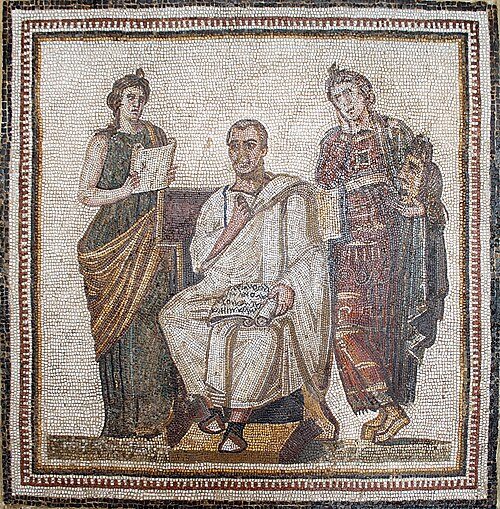
The golden late afternoon light lies across Virgil’s fields on his estate in Campania Italy.
Virgil stands beneath an old oak, its branches heavy with summer, when Maecenas arrives — not with retinue, but alone, riding slowly, as if he wishes to disturb nothing of the quiet pastoral world Virgil has built from near‑ruin.
Maecenas dismounted, brushing dust from his cloak.
Maecenas : Your estate is peaceful, Virgil. A not so rare thing in Italy now. I’ve come with an invitation — to join the literary canon I’m assembling. A Roman canon to rival the Greeks. Rome needs authors who can shape her soul.
Virgil’s expression tightens, though his voice remains gentle.
Virgil : My soul was nearly shaped into nothing. My family’s land was marked for confiscation. Caesar’s soldiers have taken it. Only my fame as a pastoral poet saved me. I write because I survived, not because I belong.
He looks toward the distant hills
Virgil : My culture is Gallic. Rome’s natural enemy. Rome does not invite us into her canon; she erases us.
Maecenas : Then we are brothers in erasure. My people were Etruscans — exterminated more thoroughly than the Gauls. Rome began as bandits on the Tiber Hill, and they devoured us first. To survive, one must make peace with Rome, not flee from her shadow.
He steps closer, lowering his voice.
Maecenas : I am making peace by replacing Roman culture with European culture — a new identity for all the peoples Rome has conquered. Even the divine Julius Caesar and Augustus descend from conquered Italian cities. We are all conquered, Virgil. That is why we must write.
Virgil’s eyes darken..
Virgil : Then hear a story of. a Gallic city Avaricum — barbaric and proud, ringed with forests. Caesar’s army, by his own record slaughtered, 40,000. Less than a thousand escaped, starving, ill shod, carrying their goods and idols in sacks. As refugees, they wandered into my province, Cisalpine Gaul. My father out of pity for fellow Gauls took in a small group as voluntary slaves. At least that is what he told me. As a young man, I caroused with them in their slave quarters. They told me harrowing stories about the sacking of Avaricum and their escape to Cissalpine Gaul. They said, Caesar had such a slave market glut, he let them pass through his lines. Some of the soldiers gave them food and clothing. Others stole their sacks and raped them. Their leader in our household was my age. He said he was the younger brother of their murdered leader , Vercingetorix. Our household called him Aeneas in a cruel reference to Greek mythology. I taught him to read and write so he could be a clerk and not a field worker. In return, he taught me Gallic lore and songs.
Maecenas listens without flinching.
Maecenas : Tell that story. But tell it inside a greater one — a subset tale within an epic of Rome’s official glory. Let the refugees walk through your verses. Let their suffering stain the marble. Let their truth live inside Rome’s myth. You reference to your slave, Aeneas seems a good omen. Tell an allegory of his story as Rome's national epic for future generations of Romans.
"For a beginning to your epic poem , I will let you into Rome's greatest secret. The Gauls were not defeated. Caesar was at the brink of withdrawing his armies back to Italy. But Caesar to restore his and Rome's glory, committed a terrible sin. He had his most loyal and capable lieutenant Labienus smuggle himself in a wooden horse drawn cart filled with water barrels, into the camp of Vercingetorix. He carried to Vercingetorix a truce from Caesar. He and Caesar would unite to rule Gaul. Casear would keep conquered Gaul and Vercingetorix the rump remnants. Labienus would rule in lieu of Caesar who would return to Italy and never return to Gaul. Labienus promised all of Gaul would now share in the blessings of Roman civilisation. But unconquered Gaul would remain free under Vercingetorix and his descendants for ever. Then Labienus in lieu of Caesar swore Rome's most solemn oath to keep their word. I will not tell you. But you know it refers to Jupiter. Labienus was popular in Gaul even among Rome's enemies. They trusted him as a former Governor of Cisalpine Gaul and a restraint on Romans' worst practises. So Vercingetorix trusted and believed him now. Labienus too trusted Caesar's oath.
The next morning after a jolly night of Roman and Gaul friendship inside Vercingetorix's quarters, Vercingetorix and Labienus rode into the Roman camp. Caesar was sitting on his tribunal platform. Labienus was surprised at Caesar's hostile demeanour.. He sensed danger and whispered to Vercingetorix, "Gallop back to your camp." But with the barbarians' piety to oaths, Vercingetorix dismounted and knelt as hands clasped supplication before Caesar.. At a sign from Caesar, his retainers seized and trussed him like a bull. They masked his face and dragged him furiously groaning struggling, away to the camp prison. Vercingtorix, denied contact with Gauls who would understand his accusations against Caesar, was taken to Rome. In accordance with Roman ritual, he was paraded in Caesar's triumph and then executed.
Labienus did not say a word about the betrayal. Instead he joined Pompey in the civil war in the futile hope of restoring Vercingetorix. He planned to treat Gaul as Pompey has treated Asia. Labienus died at the battle of Munda, always embittered that he had taught Caesar to be a great general and Caesar had betrayed him and his ally Vercingetorix. As a belated redemption, Caesar gave him an honourable military burial.
Virgil : Who told you this greatest secret?
Maecenas : (looks around) Caesar at a drinking bout told his boy nephew, Octavian. He said. "As you may one day be master of the world, you should know the dirty trick that won it. But it must never appear in a book. He who tries to dies with his family.
Maecenas : Augustus told me as he tells all his inner circle. He jocularly called the treachery, the wooden horse of Avaricum. Maybe, that stratagem was the wooden horse treachery at Troy, embellished and turned into myth by poets. That too is a good omen for your Aeneid.
Virgil stares at him, torn between bitterness and the strange hope Maecenas always carries like a torch.
Virgil : You want me to write Rome’s triumph — and smuggle grief inside it ?
Maecenas : I want you to write Italy. A land made of wounds. A land that Rome cannot conquer because it already lives inside her. Write the epic that makes Rome answer for what she has done.”
The wind moves through the oak leaves like distant applause.
Virgil exhales slowly.
Virgil : Perhaps… perhaps an epic can hold both worlds.
Maecenas places a hand on his shoulder.
Maecenas : Then begin. Let the Gallic refugees walk beside Aeneas. Let your past speak through Rome’s future.
A workshop‑style scene: Virgil alone at his desk, shaping the architecture of Book II)
Scrolls lie open: Caesar’s Gallic War, Ennius, Homer, and his own rough notes. He dips his stylus, pauses, and begins to shape the hidden structure.
Virgil : The wooden horse infiltrators must seem omniscient. Some reader will ask: how did they map Troy ?
He drafts a line: And the infiltrators knew the paths through the darkness.
Virgil : no explanation. No accusation. Only the effect.
He writes a note in the margin: Two horses: one of wood, one a wooden cart.
Name the first; imply the second.
Let the city fall from within before it falls from without.
Virgil closes Caesar’s book. He does not want to write the brutality directly. Epic decorum forbids it. But he can encode the emotional truth.
He drafts: A people scattered across the world…
He adds: Aeneas carries Anchises an emblem of elders carried by sons. Ascanius an emblem of a child saved from loss. Creusa’s loss and death an emblem of the unspoken fate of women in wars.
He writes: The fall of Troy is not only fire. It is dispersal. Memory broken. Lineage severed.
He drafts a line: not all of Troy dies
Then beneath it: but part lives in sorrow, in servitude
He hesitates. He scratches out the second line. Too explicit.
Part survives, part is conquered…
He nods. Enough. The reader will understand.
He whispers: Troy must fall twice, so Rome may rise once.
He rolls up the draft, ties it with cord, and sets it aside for Maecenas.
He nods. Enough. The reader will understand.
Maecenas' house at Rome, late afternoon.
Maecenas sits in his shaded library, scrolls spread before him. Virgil’s newest draft lies open — the encoded architecture of Troy’s double fall. He reads slowly, lips tightening, then softening, then tightening again.
Virgil stands nearby, hands clasped, waiting.
Maecenas: You’ve done it, Virgil. You’ve hidden the truth so deeply that only the wise will find it — and yet the wound will be felt by all.
He taps the margin: the double pity.
Maecenas : This line is perfect. The reader feels the echo without knowing its source. It is how history should be written: shadows first, then statues.
Virgil exhales, relieved.
Maecenas reads the line about the infiltrators knowing the paths through darkness.
Maecenas : This is dangerous, Virgil. Too sharp. You must make the infiltrators omniscient without making them informed.. Rome cannot see itself too clearly.
He circles Virgil’s note: the other wooden horse.
Maecenas : keep this idea. But bury it. Let it be felt, not seen.
Maecenas reads the line: the refugees dispersed throughout the world
Maecenas : This is the heart of it. The fall that continues after the flames. The fall that Rome repeats in every conquered land.
He looks at Virgil with a mixture of admiration and warning.
Maecenas : You must be subtle here. You cannot speak of chains. You cannot speak of markets. But you can speak of memory broken, lineage scattered, children raised in foreign tongues.
He taps the page.
Maecenas : Let Aeneas carry his father as the emblem of all elders carried from burning cities. Let Ascanius stand for all children abducted from their homes. Let Creusa’s absence and loss speak for every woman lost. Troy falls twice in your draft. First by a trick, then by dispersal.
He looks at Virgil
Maecenas : This is not just Troy’s story. It is Italy’s story. It is the story of all cities' sackings. It may one day be Rome’s story. And by making it Troy’s, you make it safe to tell. You must keep both falls. But you must hide them behind the marble of epic. Let the educated see the cracks. Let the common reader see only the statue.”
He hands the scroll back to Virgil.
Maecenas : Now refine it. Make the shadows deeper. Make the light brighter. Let Rome read its own sins without knowing it.
Virgil bows his head.
Virgil : I will.
The scroll lies open, marked with careful circles and faint warnings. Virgil sits, stylus poised, and begins the slow work of revision. He rewrites the line: twice trickery broke down the gates…
He stops. Too explicit.
He adjusts: twice our trust was deceived…
He nods. Now the first deception is the Greeks' departure — the second, the Horse.
He adds a margin note.
Maecenas: Make Greeks omniscient without making them informed.
Virgil studies his earlier draft: and the Greeks knew the paths through the darkness…
He scratches it out. Too sharp.
He replaces it with: and suddenly, through the shadows, they moved with certainty…
He smiles faintly.
Virgil : Certainty without explanation. Knowledge without source.
He writes a marginal note: let fires start in multiple quarters at once.
Let Aeneas wonder how the Greeks knew the inner ways.
He drafts a subtle hint: not the Horse alone…
He leaves it unfinished. A fragment. A whisper.
Maecenas’ warning echoes: You cannot speak of chains. Speak of memory broken.
Virgil returns to his line; A people scattered across the world…
He keeps it. But he softens the next lines.
He writes: Part fled their homeland, part followed their fate…
He pauses. He adds a quiet echo: and I know not where fate carries them…
He underlines it. This will be Aeneas’ grief — and the grief of every displaced people Rome has made.
Virgil : Let Rome read glory. Let the wise read sorrow.
He rolls the revised draft and prepares it for Maecenas.
A private reading in Augustus' library in his Palatine palace — Augustus, Virgil, and Maecenas
The Emperor sits beneath a coffered ceiling, lamplight pooling over scrolls. Maecenas stands at his right; Virgil at his left, hands folded, eyes lowered. The revised draft of Book II lies open before Augustus.
He reads slowly, lips tightening at certain lines, relaxing at others.
Augustus looks up at Virgil.
Augustus : You imply a betrayal. You do not name it. You let the reader feel it.
Virgil bows his head slightly.
Virgil : Some truths must be felt, not spoken.
Maecenas watches Augustus carefully.
Augustus reads the line about the infiltrators moving with certainty through the shadows.
His brow furrows.
Augustus : How did they know the inner ways of Troy?
He glances at Virgil.
Augustus : You do not answer.
Virgil keeps his voice steady.
Virgil: The Gods guide fate. The infiltrators act as fate’s instruments.
Maecenas steps in smoothly.
Maecenas : The epic must preserve divine causality, Augustus. Mortal cunning is only the shadow of divine will.”
Augustus nods, satisfied. He does not see — or chooses not to see — the hidden infiltrator encoded beneath the line.
Augustus : Part fled their homeland, part followed their fate…
He sits back, thoughtful.
Augustus : This is the Rome I am building — a world where peoples are scattered, then gathered again under one order.
He looks at Virgil with a mixture of admiration and warning.
Augustus : You must show that Troy’s dispersal leads to Rome’s unity. That suffering becomes destiny. That loss becomes Empire.
Virgil inclines his head.
Virgil :I will make Aeneas’ wandering the seed of Rome’s stability.
Maecenas smiles faintly — the political line has landed.
Augustus : Troy may fall twice in your poem, Virgil. But Rome must rise once — perfectly.
He hands the scroll back.
Augustus : Keep the shadows. They give the marble depth. But the surface must shine.
Virgil accepts the scroll, understanding the balance he must maintain.
Maecenas places a hand on Virgil’s shoulder.
Maecenas : You see? Even he feels the architecture. Now finish it.
Virgil sits at his cedar desk. The sea is pale silver; the lamp is still lit. Before him lie two scrolls: the draft Maecenas approved, and the one Augustus read with careful neutrality. Now he must fuse them into a single, flawless epic surface. He breathes once, deeply, and begins.
Virgil smooths the parchment and writes slowly, shaping the line that will carry the first shadow:
He adds a subtle echo : nor the Horse alone…
He stops. He scratches it out. Too dangerous. Instead, he writes a gentler ambiguity : by craft and stratagem…
A phrase Homer would approve — and Augustus will not question.
But the wise will see the second horse
Virgil moves to the aftermath — the sorting of survivors, the erasure of lineage. He cannot write chains or markets. But he can write fate.
He drafts: part fled their homeland, part followed their fate…
He keeps it. It is clean, dignified, and devastating.
He adds: and I know not where fate carries them…
This is the encoded memory of the refugees driven out by Rome— old men carried, women separated, children taken. But in the epic, it becomes Troy’s universal sorrow, not a specific atrocity.
Virgil : The shadows are deep. The marble shines. Rome will see glory. The wise will see grief.
He rolls the scroll, ties it with cord, and sets it aside.
This is the version he will recite. This is the version Rome will inherit. This is the version that hides the Gallic tragedy inside Troy’s flames.
The Palatine palace, deep night.
The palace is silent except for distant footsteps of the night guard. Augustus sits in his private study, a single lamp burning low. Before him lies Virgil’s final scroll — the polished version he approved earlier, now read again without Maecenas or Virgil present.
He unrolls it slowly.
Augustus (thinking): Twice betrayal? He names only one betrayal. The Horse. What is the other?
He leans back. He knows Virgil well enough to understand: if a betrayal is unnamed, it is deliberate.
Augustus : He has hidden something. A shadow beneath the marble.
But he does not object. He respects the craft.
Augustus : They move as if guided. As if the city were already open to them.
He taps the parchment.
Augustus : Not the Horse alone. Virgil has written a second horse — invisible, unspoken.
He considers the political implications.
'
If Troy fell from within, then Rome — born from Troy — must guard itself from internal betrayal. A useful lesson. A warning he can endorse.
Part fled their homeland, part followed their fate…
Augustus reads this twice. He thinks of Italy’s towns emptied by civil war. He thinks of Gauls displaced by Caesar. He thinks of Etruscans absorbed into Rome. He thinks of his own ancestors — a conquered Italian city.
Augustus (softly) : Fate scatters. Empire gathers.
He sees what Virgil has done: turned dispersal into destiny, loss into foundation, sorrow into legitimacy. This is the kind of myth Rome needs.
He reads the final echo: and I know not where fate carries them…
Augustus closes his eyes. He imagines Aeneas carrying Anchises. He imagines Ascanius walking beside him. He imagines Creusa’s absence — the cost of empire.
Augustus (thinking): Rome must rise once, perfectly. But its rise must carry the memory of what was lost.
He touches the scroll gently.
Augustus : Virgil has done what I asked. He has given Rome a glorious origin. But he has also given it a reflection.
He smiles — a rare, private smile.
Augustus : Good. Let the people see the marble. Let the wise see the cracks.”
He rolls the scroll, ties it, and sets it aside.
Tomorrow, he will praise Virgil publicly. Tonight, he understands him.
The Palatine atrium (living room ).
Virgil steps forward, scroll in hand. Augustus watches, Maecenas behind him. Virgil begins.
Virgil (reciting): Caesar, I speak of Troy’s night of ruin.
And in the heart of the burning city, Helen crouched in the temple’s gloom. A figure of treachery. She was the shadow within the walls, the reminder that ruin comes not only from without, but from within.
When the towers collapsed, fate scattered our people. Some fled into the world; some followed the path the Gods laid before them. I knew not where destiny carried them — only that Troy lived on in those who survived.
Thus the city fell, and thus Aeneas rose — bearing his father, leading his son, carrying the memory of a nation toward the future Rome.
Virgil lowers the scroll. The hall is silent. Augustus nods once.
Augustus Secured The Roman Borders and Ushered in The Pax Romana (the Roman Peace).
The Roman defeat at Teutoburg Forest in northern Germany (9 B.C.) was an ambush in which three Roman legions were annihilated by a coalition of Germanic tribes led by Arminius, permanently halting Rome’s expansion east of the Rhine.
The catastrophe so shocked Augustus that he would bang his head against a door and cry out : Quintilius Varus give me back my legions.
Rome abandoned plans to annex Germania east of the Rhine. The Rhine became the permanent frontier.
Teutoburg Forest preserved the independence of the Germanic peoples and shaped the long-term cultural and political map of Europe. A few years ago, I was in the former German territory of Qingdao in Northern China, While in a German restaurant, I spotted on the wall a giant mural of the battle of Teutoburg. I whispered to my family : Germany is biding its time.
Prior to the defeat of Teutoburg, Augustus had secured all the other borders of the Empire. After Teutoburg, Augustus established Pax Romana (the Roman Peace). A deprecating proverb was made about Pax Romana, by a British chieftain. But in his "desert they call it peace," a Romanised civilisation flourished. Tribal chieftains went shopping for exotic goods in the new cities, and soaked their rheumatism in the new spas.
Libertas (Liberty) As a Roman Ideal and Realities
Libertas meant the condition of being free from domination — legally, socially, and politically. It was not only an abstract ideal but a Roman status: freedom from slavery, freedom from arbitrary power, and freedom to participate in civic life. It became both a legal reality and a political slogan, especially in the late Republic.
Libertas was foremost the opposite of slavery — the state of a person who was liber, not a slave. It meant:
freedom from being owned
freedom from coercion by a master
freedom to act as a Roman citizen.
This core meaning is why the pileus, the felt cap given to freed slaves, became the symbol of libertas.
By the late Republic, libertas expanded beyond personal status into political liberty — the freedom of citizens from domination by powerful individuals or autocrats. It meant:
freedom from tyranny or one-man rule
freedom for Magistrates and Senators to act without interference.
freedom of the Roman people as a collective civic ideal.
Libertas became a rallying cry against autocratic tendencies in the early Principate.
Roman leaders like Cato the Younger and Cicero constantly invoked libertas in their rhetoric: it was the ideological heart of the Republic.
Libertas was also personified as a Goddess, with:
the pileus (cap of freed slaves)
the vindicta (rod used in manumission)
a temple on the Aventine Hill (dedicated 238 B.C.)
Her cult physically embodied the Roman belief that freedom was not just a condition but a sacred civic value.
Libertas appeared:
on Republican and Imperial coins, often as propaganda for freedom of the people
in senatorial debates, especially when resisting autocratic power
in manumission rituals, where the rod and cap made freedom legally real.
It was a lived, legal, and political reality — not a philosophical abstraction
Libertas meant freedom from domination, whether by a master, a tyrant, or an over mighty politician. It was:
a legal status (not being a slave)
a political ideal (the Republic’s freedom)
a Goddess (with temple, cult, and symbols)

In 1942, a Negro Kentucky billboard painter, Cassius Clay, named after an abolitionist, gave his son the same name in honour of the abolitionist.
Golden Age Latin
The literary circle around Maecenas played their parts well. Their works became standard school texts used to teach grammar and rhetoric. By the late first and early second centuries, they had developed into the Roman literary canon. Greek masters were studied alongside Roman counterparts - Homer with Virgil, Thucydides with Sallust and Livy, Alcaeus with Horace. The literature of the Augustan era came to be known as Golden Age Latin.
Ovid 43 B.C. -17 A.D.
A younger contemporary of the other Golden Latin poets, Ovid spelled a social and poetic reaction to the increasingly stuffy Augustan age.
Ovid was a master of elegy, mythological narrative, and erotic wit.
His Signature Work: Metamorphoses
A continuous mythological history of the world
From Chaos → Creation → Myths → Julius Caesar’s apotheosis as divine
Written just before his exile.
Ovid’s voice is playful, ironic, psychologically acute — utterly different from Virgil’s solemn epic tone.
Metamorphoses was a revolution in Roman poetry.
Ovid blends:
tragedy
comedy
erotic elegy
philosophical myth
miniature psychological dramas
An Imaginative Reconstruction

True history : Augustus died in 14 A.D. of frailty or Livia's poison to ensure his successor would be Tiberius. His last recorded words were Plautine theatre to his friends at his death bed : Have I played the part well? Then applaud as I exit.
Augustus was deified as Julius Caesar was. Livia was deified by her grandson, the Emperor Claudius. In Robert Graves' I Claudius, she requested that from Claudius to escape divine punishment as a poisoner. She told Claudius she poisoned imperial rivals. to save the Empire from civil war.
After Augustus, The Terror
Augustus' imperial successor and adopted son Tiberius lacked his diplomatic skills. The Empire was becoming restless again. Treason trials were formerly initiated by the Senate. Tiberius publicly exercised a moderating influence. The appraisal of Cremutius Cordus that Cassius was "the last of the Romans" was a blood charge on the Senators. Few of the great Patrician families survived the civil wars. Most of the Senators came from opportunistic and often shady backgrounds as Augustus' followers.
Cortus defended freedom of speech in the Senate during the reign of Tiberius. His trial — and his defiant speech have since been read as a plea for the historian’s duty to truth under tyranny.
Cordus was a Roman historian in the early Principate. His work praised Brutus and Cassius, which under Tiberius was interpreted as political sedition. He was charged with maiestas (treason), brought before the Senate, and forced to defend himself.
.
After his conviction, Cordus starved himself to death ( likely clinical depression for social ostracism) but his works survived because allies secretly preserved them — a victory for historical truth over State repression.
Cordus became a touchstone for:
the independence of historians.
the Senate’s shrinking autonomy under Tiberius
the dangers of maiestas prosecutions
the idea that history itself is a check on tyranny.
An Imaginative Reconstruction
Rome, 25 A.D. — the Curia Julia. The Senate is assembled; the bronze doors stand open to the Forum. The EmperorTiberius is absent, but his presence is felt in every silence.
The senators murmur as Cordus enters — dignified, carrying the calm of a man who has already accepted his fate. The accusers, Satrius Secundus and Pinarius Natta, sit stiffly, scrolls in hand.
Cordus : Stands at the centre. He does not bow.
Cordus : Fathers of the Senate — I am charged with treason because I wrote history. I praised Brutus and Cassius. I called Cassius the last of the Romans. If this is treason, then truth itself is treason.
A ripple moves through the chamber. Some Senators avert their eyes; others stare at him with a mixture of pity and fear.
Cordus : Our ancestors allowed historians to speak freely of kings, tyrants, and magistrates.. No one dragged them here. Why? Because Rome once believed that memory is not a crime.
Augustus called Livy a Pompeian, but with a smile; the remark was a jest, not a charge, and Livy went on writing the history of Rome without fear.
He turns toward the accusers.
Cordus : You say I have injured the majesty of the Roman people. But I have only written what all men know — that Brutus and Cassius fought for the Republic. If their names cannot be spoken, then the Republic itself cannot be remembered.
I wrote history. I praised Brutus and Cassius, men long dead. If this is treason, then truth itself has become treason.
Historians of earlier ages spoke freely of kings, tyrants, and magistrates. They praised whom they wished, condemned whom they wished. Rome once believed that memory was not a crime.
I have harmed no living man. I have only recorded what all know — that those who fought for the Republic believed they fought for liberty. If their names cannot be spoken, then the Republic cannot be remembered.
Burn my books if you must. But you cannot burn the minds of men. Others will write what I have written. Others will remember what I have remembered. Truth, though suppressed, will rise again.
I ask for no acquittal. I ask only that you understand what you destroy: not a man — but history.
A Senator coughs nervously. The silence grows heavy.
Cordus raises his voice — not loud, but clear enough to carry to the back rows.
Cordus: If my books offend the powerful, let them burn them. But they will not burn the minds of men. Others will write what I have written. Others will remember what I have remembered. And the truth, though suppressed, will rise again.
He pauses. The Senate is utterly still.
Cordus : I ask for no acquittal. I ask only that you understand what you destroy. Not a man — but history.
Cordus steps back. No one moves to stop him. He walks out of the Curia with the same calm he carried in, leaving the Senate frozen between fear and shame.
The bronze doors close behind Cordus. A long silence hangs over the chamber — the kind that makes us aware of our own breathing.
For a moment, no one speaks. The Senators sit rigidly, eyes fixed on the floor or the ceiling, anywhere but on each other.
Then elderly Haterius, clears his throat.
Haterius : Fathers, the man has confessed his crime. He praised enemies of the state. The law of treason is clear.
A few senators nod — not in agreement, but in fear of being seen not nodding.
Across the chamber, Marcus Lepidus, calm and Patrician-like raises a hand.
Lepidus : Is it treason to praise the dead? Is it treason to remember the Republic? Cordus spoke boldly, yes — but he spoke as a historian, not a conspirator.
Haterius : Boldness is itself dangerous. Words stir minds. Minds stir action. We must think of the safety of Rome.
Lepidus : Or of the safety of ourselves.
A murmur ripples through the benches. Lepidus continues, voice steady.
Lepidus : We have seen too many men accused for what they said, not what they did. If we condemn Cordus, we condemn the freedom to speak truth about our past. And if our past cannot be spoken, what future do we imagine for Rome?
A younger Senator, Arruntius, leans forward.
Arruntius : The Emperor is not here, but he is listening. We all know how these trials end. Cordus has already chosen his fate. The question is what we choose ours.
Silence again. The senators look at one another — each waiting for someone else to speak first.
Finally, Ateius Capito, a jurist with a voice like cold iron, rises.
Capito : Let us not pretend we are free to decide. Cordus is guilty because the accusers say he is guilty. Because the climate of the times says he is guilty. Because fear says he is guilty. We can vote, yes. But we cannot choose.
A few Senators close their eyes, as if the words sting.
Lepidus : Then let the record show that some of us spoke for moderation. Even if moderation cannot prevail.
Cappito : Very well. Let the consuls record that the Senate, compelled by law and circumstance, proceeds with the charge.
The Consuls rise. The scribes prepare their tablets.
No one looks proud. No one looks triumphant. They look only relieved — relieved that the moment of decision is passing, relieved that they have not been singled out, relieved that the danger is shifting away from them.
As the votes are cast, the chamber feels smaller, as if the walls themselves have moved inward.
Outside, the Forum is bright with sunlight. Inside, the Senate votes in shadow for conviction.
This debate in the Senate, demonstrates the Roman ambivalence. Cordus is not simply hauled away and executed in a Court despotism. Everyone in the Senate are engaging in a Roman drama. Cordus is permitted to walk away and give himself a dignified Roman death.
Tiberius 42 B.C. - 37 A.D.

Tiberius was a pious believer in the old Republic. He sincerely tried to engage in a partnership with the Senate. Like Augustus, he took part in Senatorial debates. He was sometimes the sole dissident voice and voter in the Senate. But it remained play acting. Finally, Tiberius grumbled. "Free men born slaves" and retired to Capri island. He left the Government and the Empire to his mother and his Praetorian Prefect Sejanus.
Tiberius was seen by his supporters in his Principate and in later history as a model of good governance. A dull peaceful tranquility settled over the Empire. When his nephew Germanicus invaded Gerrmania to avenge the battle of Teutoburg, he ordered his withdrawal. He instructed Roman Governors not to shear the sheep too closely in Winter. To his detractors, he was seen as paranoid and tyrannical. Legends of a tyrannical ruler grew around him His aha moment was his saying, "Let them hate me as long as they approve". In Capri, he abandoned that cynical sentiment for a sybaritic life. His death on Capri was celebrated by the mobs in Rome as "Tiberius into the Tiber". Outside Rome there was mostly public silence. He staged the first purge after the civil wars when his Praetorian Prefect Sejanus tried to be co-Emperor with him. Sejanus was a precursor of the Praetorian Guards' usurpations in Rome.Tiberius was given a dignified burial but not divine status. He was the only Roman Emperor to be neither made a God nor erased from public memory.
The historical records of the tyranny of Tiberius and later Emperors make gothic and gory reading. Some equivocations should be considered. The historians were nostalgic for the Republic and not generally in sympathy with imperial needs. They highlighted the worst cases. Lists of maiestas might be made about a victim and the most ludicrous charge be reported by historians. Walking into a public lavatory with a coin engraved with Caesar's head would not otherwise lead to execution. Informers' charges against a person would lead to others in moral panics. Imperial tyrannies rarely affected the 60-75 million citizens and subjects in the Empire outside urban Rome. Life continued there as mostly vibrant and upward. Even in urban Rome, maiestas prosecutions rarely had victims outside the small minority of Patricians and the rich common people.
Marcia
Marrcia was the daughter of Cordus. After Tiberius died in 37 A.D., Cremutius Cordus’ suppressed history returned to circulation. The new Emperor Caligula ordered it republished from the copies hidden by Marcia and Cordus' friends
Caligula presented himself as undoing Tiberius’ cruelties. Caligula, contrary to legend, operated within the bounds of sanity. The histories about him are made up or exaggerated. There is no record he made his horse a Senator. He sought to make the Empire an Eastern despotism with himself as a God. But the Roman people were not ready for that. His public release of Cremutius' history was a strategic move to discredit the mostly phoney Senate. As a God, he had no reason to fear the discrediting of his dynasty. As Zeus/Jupiter had no reason to fear the history about the tyranny and cannibalism of his Titan father Cronos.
Marcia had hidden copies during the purge; once Tiberius was gone, she helped re‑publish them.
Cordus’ relatives removed the “most offensive” anti‑tyrannical lines before wider circulation—likely to avoid provoking another prosecution. That is the common historian's practice of disguising text with euphemistic words. Historian A. J.P. Taylor lost his Oxford Professorial employment with a single written sentence. He switched to social history and wrote his best book.
Rome throughout her history was officially and mostly in practice, a male dominated society. A society where men held the power of Pater familias, (father of the household) left little independent space for their women.
However there are a few other shining lights of women leaving their female domains for politics. There is Livia and Marcia and Portia. Others will be covered in later blogs
The Lex Oppia (215 B.C.) was a wartime austerity law passed during the Second Punic War. It restricted women's luxury items and independence.
These restrictions were meant to conserve resources but they stayed in force long after the emergency ended.
When tribunes proposed repealing the law, conservative senators—especially Cato the Elder—fiercely opposed it. Women responded with an unprecedented political action:
They flooded the streets of Rome.
They surrounded the entrances to the Forum.
They petitioned magistrates directly,
They blocked Senators’ access and demanded repeal.
Livy describes them as forming a mass movement, pressing every man of influence until the vote shifted.
The repeal passed overwhelmingly. Women regained:
freedom of adornment
control over certain personal property
symbolic civic agency.
Portia
Portia was Marcus Brutus’ wife, daughter of Cato the Younger,
She was born into the Stoic, household of Cato. She inherited:
his philosophical severity
his moral absolutism
his contempt for tyranny
his belief that virtue mattered more than life
She married Brutus c. 45 B. C., The marriage was a union of two intensely principled minds.
Plutarch emphasises her intellectual equality with Brutus — she was not a passive spouse but a partner in thought.
When Brutus refused to tell her his plans against Julius Caesar, Portia stabbed her thigh with a concealed knife, then endured the wound in silence for a day. When Brutus discovered it, she said: “I am Cato’s daughter.”
Brutus was distraught and finally told her of the conspiracy. Plutarch reported after the Ides of March, she killed herself by swallowing hot coals. Prior to feminism, revolutionary women are known to out pace their male partners in political acts perhaps as compensation for being left out of conspiracies
An Imaginative Reconstruction
Rome, Night. The house of Cordus.
The lamps burn low in the atrium. Marcia stands before a cedar chest sealed since the day her father starved himself. Dust lies thick on the lid; she brushes it away with a trembling hand.
She lifts the lid.
Inside are the hidden scrolls — her father’s history, copied in secret by friends, smuggled out of the house before the Senate’s order to burn them. The papyrus edges are brittle, but the ink still holds its shape.
She whispers:
Marca : Father… Rome is no longer ruled by the man who feared your words.
Two men enter quietly: Atticus, an elderly scribe who once worked with Cordus, and Lucius, a younger copyist loyal to the family. They bow their heads to Marcia.
Atticus : Is it true, Caligula has lifted the ban?
Marcis : He has. Rome must remember what Tiberius tried to erase.
She lays the first scroll on a table. The opening lines — the rise of the Republic, the virtues of Brutus and Cassius — glow in the lamplight like embers.
Marcia’s voice steadies.
Marcia : We copy everything. Even the passages my cousins softened. My father wrote with courage. Let Rome read him as he was.
Atticus nods, though his eyes flick toward the door.
Atticus : There are still men who served Sejanus. They may not welcome this.
Marcia smiles — not with warmth, but with resolve.
Marcia: Let them fear a dead historian. Let them fear memory.
Lucius unrolls a fresh sheet of papyrus. The scratching of the stylus begins — slow, careful, reverent. The room fills with the sound of history returning to life.
Outside, Rome sleeps under a new emperor. Inside, Marcia watches her father’s words cross from forbidden to reborn.
Roman hours pass into sun rise. Scrolls multiply. The chest empties.
At dawn, Marcia steps into the courtyard, holding the first completed copy. The sky is pale gold over the rooftops.
She speaks softly, as if to the absent man whose courage shaped her own:
Marcia : They tried to burn you. But truth has a way of breathing again.
She hands the scroll to Atticus.
Marcia : Take it to the libraries. Quietly at first. Let Rome rediscover what it lost.
Atticus bows and departs into the morning light.
Marcia stands alone, the house silent behind her — but the words of Cremutius Cordus, once condemned, now moving again through the city like a returning tide.
Claudius A Reconstruction 10 B.C - 54 A.D.
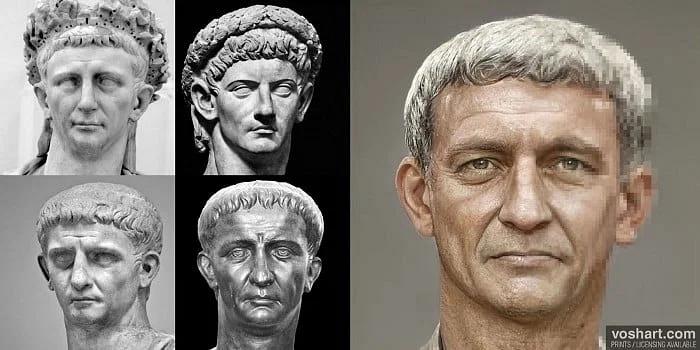
Claudius was born at Lugdaunum — the first Roman emperor born outside Italy. His disabilities (limp, stammer, tremor) led his family to dismiss him as useless, which ironically saved him from the purges under Tiberius and Caligula. After Caligula’s assassination in A.D. 41, the Praetorian Guards proclaimed him emperor, making him the last adult male of the Julio‑Claudian line.
After the assassination of Caligula, the Senate in an extraordinary session, debated to restore the Republic and damnatio memoriae the Caesars. But the Roman mob forced upon them their new Emperor, Claudius with all the entitlements of the Principate. The Senate's historical memory was primarily the ancient Republic. The mob's historical memory was primarily the civil wars. The Empire under Caligula was facing ruin. Claudius turned out not to be the doddering professor. He may have secretly engineered the assassination to save himself, his dynasty and the Empire. The Praetorian Guard assassinators were all executed under his orders. But every surviving Praetorian Guard received a large donation from the new Emperor. That was a precursor to later imperial donations to the Praetorian Guards by the new Emperor. Claudius ordered the destruction of the Acta Senatus senatorial minutes for that day. One could say the Senate failed in restoring the ancient Republic because their response was a reflex not a aha. They would not make that mistake again. The mob succeeded because they wanted to keep their security and their bread and games.
Claudius was the heir apparent after Tiberius. Tiberius considered him too enfeebled to be Emperor. After his accession, the little daughter of Caligula was murdered to eliminate the blood line of Caligula. She at least was not sexually violated and executed as was Sejanus' little daughter to obey an ancient decree that virgins could not be executed. The new Emperor was religiously conservative but already showed his humanity against inhumane rituals.
Claudius declared he had been compelled to become Emperor in the crisis of the assassination of Caligula by the Praetorian Guards.
His disabilities had denied him the conventional Patrician senatorial and military career. So he had pursued scholarship instead. His life time of reading and writing about the histories of the Etruscans, the Carthaginians and his own Romans, gave him unique insights into the fatal flaws of the Roman Government.
An Imaginative Reconstruction
Civilis arrives at the Volusii house on the Esquiline hill in Rome, wearing Batavian dress, speaking rough Latin. Quintus Saturninus, the same age, sixteen is assigned to “look after the Batavian guest".
The next morning, the boys saunter through Rome. They are immediately noticed as Patrician boys from their togae viriles and the crowd parts for them. No guardian accompanies them. Retribution for their molestation would be terrible..As a Roman citizen and a Batavian ally of Rome, Civilis was permitted to wear the toga virilis. The sun strikes the marble of the Forum of Augustus, turning every column into a blade of light. Civilis squints; he has never seen stone shine. In Batavia, buildings are timber and earth. Here, even the shadows curve..
Quintus is with the easy confidence of someone who has never doubted his place in the world. His toga virilis is perfectly arranged; Civilis’ borrowed one is already slipping.
“Hold it like this,” Quintus murmurs, adjusting the fold. “Rome notices everything.”
Civilis nods, embarrassed but determined. He is here to learn.
They step into the portico. Statues of Rome’s great men line the walls — Aeneas, Romulus, the Kings, the Consuls. Civilis stops before the statue of Romulus, staring at the wolf‑skin cloak.
Quintus watches him with a half‑smile.
Quintus :You like him?
Civilis : He looks… wild.
“
Quintus : He founded the city. We honour him because he made order out of chaos.
Civilis : In Batavia, we honour men who survive chaos.
Quintus (laughs softly) : Then you’ll fit in here better than you think.”
They walk down the Sacred Way toward the theatre of Marcellus. Civilis slows again, staring up at the massive arches.
Civilis : Is this a fortress?
Quintus : For plays.
Civilis : Plays?
Quintus :Stories. Performed by actors.
Civilis : In Batavia, stories are told by old men around the fire.
Quintus : In Rome, we build a monument for everything — even stories.
Civilis touches the stone, feeling its cold smoothness.
Civilis :Your people must be very sure of themselves.
Quintus : We have to be.
Winter steam curls from great bronze doors. Civilis hesitates.
Civilis : This is a temple?
“
Quintus (amused) : This is Themae Agrippae .Come in.
Inside, Civilis is overwhelmed: mosaics, fountains, marble benches, men discussing politics as if nakedness were nothing.
They enter the apodyterium, ( changing room). Civilis watches men strip without hesitation, folding their clothes neatly or tossing them to slaves. Quintus begins to undress, moving with practised ease.
Civilis hesitates. His toga suddenly feels too tight, too foreign. He glances around — at the younger boys laughing, at the older men talking politics, at the attendants rubbing oil on patrons’ shoulders.
Quintus (gently) : Hold your head high. Rome notices everything.
Civilis forces himself to breathe. He removes his tunic, folding it carefully. The air is warm on his skin. He feels exposed — not ashamed, but visible in a way he has never felt before.
They walk to the frigidarium, (cold pool).
Quintus : You' ll get used to it.
They jump into the frigidarium, and shivering hurry to the Stagnum, (heated communal pool).
Civilis steps into the water, startled by its warmth.
Civilis : In Batavia, the river is always freezing.
Quintus : Rome improves everything.”
Civilis splashes him.
Civilis : Not everything.
Quintus playfully ducks Civilis.
Civilis ducks him. They almost come to blows before both retreat laughing.
Quintus splashes back. For a moment, they are simply boys.
The boys walk from the Baths.
Civilis is quiet. Quintus notices.
Quintus says : You're thinking..
Civilis :About home. In my homeland, we bathe in the river. The water is freezing. It wakes you like a slap. You go in with your family or a cohort. There is no marble. No attendants. No oil. No steam. Just the river. You wash quickly, because the cold bites. You talk about hunting, or the next march, or nothing at all. And you never see strangers naked. Only your own people.”
Quintus: Rome is different.”
Civilis exhales.
Civilis : Rome is… exposed. Everyone together. Senators, merchants, boys, slaves. No shame. No hesitation.
Civilis shakes his head, still trying to understand. In Batavia, nudity is natural. But it is private. It belongs to the tribe. Here, it belongs to the city. About men and women, Rome is more modest. In Batavia, families swim naked together in the river. Men and women, boys and girls.
Quintus glances at him.
Quintus : Rome separates the sexes. It’s proper. Romans think bathing together makes all men equal. At least for an hour.
Civilis : Does it?
Quintus laughs softly.
Civilis : No. But we pretend.
Civilis : In Batavia, the river makes you feel alive. In Rome, the bath makes you feel… watched.
They climb the Palatine. Civilis stops again, staring at the palace rising like a mountain of stone.
Civilis : Does the Emperor live there?
Quintus : Yes.
Civilis exhales.
Quintus : It looks like a God’s house.
Quintus : That’s the idea.
Civilis studies the palace carefully.
Civilis : In Batavia, a leader must be close to his people.
Quintus : In Rome, a leader must be above them.
Civilis : Which way is better?
Quintus shrugs. We are young men. But ask me when I’m older.
Civilis smiles: Ask me when I’m Emperor of ... Batavia.
Quintus laughs — but something in Civilis’ eyes makes him pause. The Batavian boy is joking, but not entirely.
They sit on a low wall overlooking the city. The rooftops stretch to the horizon; the Tiber glitters like a blade.
Quintus :You’re not like the other foreign young men.
Civilis : Is that good?
Quintus : It means you might be dangerous one day.
Civilis : Rome wants me to be for them..
Quintus studies him — the broad shoulders, the sharp eyes, the quiet intensity.
Quintus : Just promise me, that when you become dangerous, you’ll remember who showed you the city.
Civilis : kisses him.
Quintus : I will.
The two boys walk along the Sacred Way, the noise of Rome swelling around them: vendors shouting, litters passing, the clatter of legionary boots.
Quintus points to a statue of Julius Caesar near the Regia, the office of the Pontifex Maximus and legendary residence of King Numa.
Quintus : Do you know his famous words after a great victory?
Civilis nods eagerly.
Civilis : Veni, vidi, vici. He said it after conquering Britain.
Quintus (stops ) Britain? No. Caesar never conquered Britain.
Civilis blinks.
Civilis : But he crossed the sea into Britain.
Quintus : Yes, and then he left. Twice. Britain is still independent.
Civilis : stares at him, stunned.
Civilis : Independent? Against Rome?
Quintus shrugs.
Quintus : Rome wins most wars. Not all.
Civilis looks again at Caesar’s statue — the divine Julius, the man Batavian elders spoke of with religious awe. The idea that he had failed is like hearing that the Rhine has flowed backwards.
Civilis : I thought Rome was invincible,
Quintus smiles faintly.
Quintus :Rome is powerful. But not invincible.You will see that in the Curia Julia (Senate House).
They approach the Curia Julia, where Senators in white togas gather like a flock of seagulls aound a ship. Civilis feels his heart quicken. This is the place where Rome decides the fate of nations — including his own. Quintus waves to his senatorial father, Lucius Satuninus who smiles at them and waves back.
Quintus whispers : Stay close. Don’t speak unless spoken to.
Inside, the air is cool, heavy with incense and tradition. Civilis sees :
the Consuls seated at the front
the Senators arranged by rank
scribes ready with wax tablets
lictors holding fasces.
Lucius is speaking — a very elderly man with a gravitas having lived through all the wars since the Cleopatra war.
Lucius : The Pro Praetore of Upper Germany requests additional Batavian cohorts. The frontier is unstable. The tribes beyond the Rhine grow restless.
Civilis stiffens. His people are being discussed like assets, not allies.
Another Senator rises.
Senator : We must consider the burden on the Batavians. They have supplied Rome faithfully for generations.
Civilis glances at Quintus, surprised.
Civilis : They speak of us with respect.
Quintus : Some do. Others only see numbers.
A third Senator:— (younger) : The Batavians are loyal because they fear us. Let us not forget that.
Civilis feels heat rise in his chest. Quintus notices.
Quintus : (whispers ) Remember, This is Rome. Everyone speaks boldly here. Even idiots.
Civilis watches the debate unfold — Senators arguing, interrupting, gesturing. It is not the unified, unstoppable Rome he imagined. It is loud, divided, proud, insecure, brilliant.
He thinks : Rome is strong because it argues with itself. Rome is weak because it argues with itself.
A hush falls. Civilis feels the atmosphere become more tense.
Caligula enters with a small entourage — perfumed, radiant, theatrical. His purple cloak trails The Senators bow deeply, too deeply.
Civilis (whispers ) : He looks like a God.
Quintus (whispers ) : He wants you to think that.
Caligula pauses, surveying the room with a smile that is both charming and dangerous.
Caligula : Continue,
The Senators resume their debate, but now every word is careful, every gesture measured.
Civilis sees how Rome’s greatest men bend themselves around the Emperors's moods.
He thinks: : Rome is strong because she has Emperors. Rome is weak because she has Emperors.
As they leave the Curia, Civilis is quiet. Quintus studies him.
Quinstus : You look troubled.
Civilis shakes his head.
Civilis : No. I understand Rome better now.
Quintus : How so?
Civilis looks out at the Forum — the temples, the crowds, the statues of conquerors and lawgivers.
Quintus (softly) : Rome is magnificent. The Emperor is a God but she is not.
Quintus : You sound like a Proconsul after a wine.
Civilis smiles.
Civilis : I sound like a Batavian.
Quintus laughs, but uneasily.
Morning lesson the next day.
The boys are seated on low stools in the peristyle (out door porch), tablets open, practicing declamation. The Winter sun slants across the Saturninus house. Civilis is still struggling with Latin meter; Quintus corrects him with the confidence of a Roman born to rhetoric.
Their Greek tutor, Philostratos, normally serene, rushes in with his cloak half‑fastened.
"Boys—inside! Quickly!"
He has forgotten to call them men.
Quintus stands.
Quintus : Magister, (master) what?
Philostratos’ voice trembles. “ The Emperor has been assassinated.”
Civilis freezes. : Assassinated? A God ?
Philostratos : Yes. A God — and now the streets call him by his army pet name again. Caligula (booties). The Divine Gaius is dead.
Civilis feels his stomach twist. Rome’s Gods can die? Rome’s Emperor can be struck down like any tribal chieftain?
Philostratos continues breathlessly: : The Senate has declared by now the return of the Republic. Your father, Quintus, has already proposed a motion for the damnatio memoriae of all the Caesars. It may have passed.
Quintus’ eyes widen.
Quintus : All the Caesars?
Philostratos: All. Even Augustus.
Civilis is stunned.
Civilis : But Augustus built this world.
Philostratos : And Caligula destroyed it.
Slaves are rushing through the corridors :
bolting doors
carrying spears and kitchen knives
dragging furniture to barricade the atrium (living room)
whispering prayers to household gods.
Civilis has never seen Roman slaves armed. It feels like the world has cracked open.
Philostratos : Stay inside. Do not approach the windows. Rome is tearing herself apart.
The boys sit together, listening to distant shouting from the streets.
The Subura lies just below the Esquiline — Rome’s densest, loudest, most chaotic district. When Caligula is assassinated, panic spreads upward.
While Philostratos rushes brainlessly around the villa, the boys creep to a shuttered window.. There, they watch :
freedmen running uphill
women clutching baskets or children
older men shouting warnings
boys racing ahead of their families
vendors abandoning their stalls
They listen to the shouts :
Caligula is dead!
The Praetorians are killing Senators!
The Senate has taken control!
They watch :
clients pounding on the gates
messengers arriving breathless
slaves refusing entry
a crowd forming outside the walls
mounted Praetorian guards
dust clouds from crowds surging through the Subura
smoke from torches
the distant roar of thousands of voices :Give us back our Caesars — not civil war!”
We want an Emperor, not chaos!
Civilis :They’re angry.
Quintus : They’re terrified. Rome hates uncertainty.
More voices surge up the hill: No more killing! Where is the Senate? Stop the fighting!
Quintus steps toward him. Magister — the crowd is shouting for the Caesars.
Philostratos :Yes. They fear civil war. They fear the Senate will fight the army.
Civilis : Will they?
Philostratos forces calm into his voice — the kind tutors use when boys are frightened : No. No, boys. The Senate will disperse them. They will restore order. They always do.
But his eyes flick toward the gate — toward the shouting, the pounding, the rising panic.
Civilis sees the fear behind the reassurance.
Rome is not burning — but it is boiling over.
Philostratus ushers the boys to the study room.
Philostratos (tries to steady himself) : We will continue our lessons. Rome is reborn today. You must understand how Republics are made.
He hands them a passage from Livy — the story of Lucretia, whose rape by the King’s son led to the expulsion of the Tarquins and the founding of the Republic.
Quintus declaims first, voice trembling with excitement.
Civilis follows, his accent thick but his emotion real.
Philostratos paces behind them, whispering: Do you see? Tarquin Superbus was a tyrant. He violated Rome. Just as Caligula did. Today, Rome casts out her tyrant again.
Civilis feels the words burn into him. Rome is not invincible. Rome can be violated. Rome can rise again.
Quintus whispers : We are living Livy.
Philostratos nods : Yes. Today is the day Rome becomes Rome again.
The boys are electrified — two sixteen‑year‑olds witnessing the collapse of an Emperor.
Evening Lesson
Everything is quieter now. The barricades remain, but the shouting outside has faded. Civilis and Quintus sit waiting for news.
Philostratos enters slowly, his face pale, his hands shaking.
Quintus stands.
Quintus: Master? Has the Republic been restored?
Philostratos : No.
Civilis : What happened?
Philostratos speaks with a hollow voice : Claudius has been proclaimed Emperor.
Quintus : Claudius? Who is Claudius?
Civilis : I have never heard of him.
Philostratos : Few have. He is the younger brother of the divine Germanicus. A scholar. An historian. A man who never sought power.
Quintus whispers : But the Senate—
Philostratos : The Senate was brushed aside, The Praetorians found Claudius hiding behind a curtain in the palace. They lifted him onto a litter and hailed him Emperor.
Civilis : So the Republic lasted only a few Winter hours.
Philostratos (glumly) : Rome has an Emperor again.
Philostratos (brightens up) : Claudius is a scholar. A man of books. He has written histories. We will read from his work on Carthage.
He hands them a passage. His fingers tremble.
Quintus reads: Queen Dido, fleeing Tyre, tricked the Berbers by claiming only as much land as could be encompassed by an oxhide.
Civilis reads the next line: …and by cutting the hide into thin strips, she encircled a great space. The Berbers were angered, but soon recognised the virtue of civilisation.
Philostratos : Carthage was founded by cleverness. By negotiation. By the union of peoples.
Centuries later, after misunderstandings between Carthage and Rome, the Divine Julius Caesar rebuilt Carthage as Rome's second greatest city in Africa.
Civilis looks up. So Claudius honours Caesar?
Philostratos’ hands shake harder.
Philostratos : Yes. Claudius honours the Caesars. He honours the Empire. He will restore order — the order of Augustus.
Quintus (whispers) : But this morning we damned the Caesars.
Philostratos : This morning is already history.
Civilis watches the tutor’s trembling hands and thinks:: Rome changes as fast as a man can say aha.
Quintus suddenly remembers. He becomes frantic.
Quintus : What is going to happen to my father ?
Philostratos : Claudius ordered the burning of yesterday's senatorial minutes. They say he is pietas like the old Romans. We can only pray. A freedman of his tapped your father on his shoulder. He whispered to him. "Support the proclamation of the new Emperor and Caesar will soon appoint you the next Praefectus Urbi. There you can devote your hours to real Roman sewerage and stay out of imperial mischief." If that is true, your house of Saturnisus is secure and you can aspire to one day be Consul. But no Saturnisus will ever be Brutus or Caesar. You Civilis can aspire to be chief of the Batavians and an immortal hero for freedom for your people. Maybe as mature men you will meet again and return peace between the Romans and the Batavians. I suspect Claudius staged a bloody farce. Taken out to be Emperor from behind a curtain sounds Plautine. And never forget, today never happened. One day, historians will write about it and marvel at its absurdity for a great people.
True History : There is no record that Civilis visited Rome. However, sons of allied rulers did customarily visit Rome as guests to improve their Roman education and form friendships with influential Romans. Both Civilis and Quintus were sixteen in the year of Caligula's death. Civilis grew up to become a major rebel of Rome. Quintus served as a Consul. His father Lucius was appointed a Praefectus Urbi by Claudius. Claudius' magnanimity towards his senatorial usurpers secured his reign. After Claudius destroyed the senatorial minutes, what happened in the Senate on that day became the stuff of legend and conjecture.
Lucius joined the line of Praefectus Urbi who kept Rome functioning for nearly six hundred years despite the Caesars and their Courts, brilliant, stupid and sometimes insane. Augustus founded this office in 26 B.C. A Mayor of a great city is always a full time occupation. As the Mayors of all great cities, they had little time to pursue higher offices.
Claudius' Rule As Caesar
The new harbour built by Claudius to secure Rome’s grain supply was an enormous artificial harbour constructed at the mouth of the Tiber, twenty five kilometres south of Rome. It became the Empire’s main deep‑water gateway for Egyptian and African grain.
Claudius began building Portus around AD 42, creating a harbour far larger and deeper than the port Ostia’s natural river mouth. Its purpose was to ensure reliable grain imports, especially during Winter shortages.
Rome’s population depended on imported grain; disruptions caused unrest and political danger. Claudius’ harbour:
reduced reliance on the shallow, silting mouth at Ostia
allowed year‑round unloading of bulk cargo
stabilised grain prices and supply by the early 60s.
Portus became the logistical heart of imperial provisioning
The story behind this project is a mix of crisis management, engineering audacity, political self‑assertion, and a very Roman fear: the grain supply failing and the people rioting.
By the 40s, Rome’s grain logistics were fragile:
The natural harbour was too shallow, constantly silting, and dangerous in Winter.
Large grain ships from Egypt and Africa often couldn’t enter the Tiber mouth.
Storms wrecked ships offshore, causing delays and shortages.
Grain riots were politically lethal.
Claudius, always mocked as weak and bookish, faced a real emergency: the capital’s food supply was unreliable. Rome could starve. The Roman proletariat lived under the worst of modern history's third world conditions.
Portus became his greatest practical achievement, a demonstration that:
he could command vast resources
he could solve Rome’s most dangerous problem
He could do what Augustus and Tiberius had not dared
An Imaginative Reconstruction
The sea is restless, heaving under a pale morning sky. Claudius stands with his cloak wrapped tight, watching the waves batter the half‑finished stakes marking the future line of the new harbour moles. The architects cluster behind him
One steps forward, bowing with theatrical humility.
Architect : Caesar, we have reviewed the latest calculations. The harbour you propose is… noble in intention. But the sea floor is treacherous, the cost ruinous, and the engineering uncertain. It is not practically or financially possible.
Second architect : Ostia can be improved modestly. But a grand port? Rome must accept its limits.
Claudius (quietly) : Augustus boasted that he found Rome a city of brick and left it a city of marble. I will turn Rome from scarcity to bounty.
The architects exchange uneasy glances.
Architect : Caesar. Marble is one thing. The sea is another. Even Emperors must bow to nature.
Claudius : Nature bows to necessity. Rome bows to hunger. And I bow to neither. You will build Portus. Build it — or else.
The architects stiffen.
Third architect : (muttering to his companions ) Perhaps the Carthaginians and the Etruscans did it in Claudius' books. This Principate is still drinking its wet nurse's milk.
Claudius’ head snaps toward him.
Claudius : The C-Carthaginian Hannibal family would have succeeded. And Rome’s Etruscan kings did build wonders. They achieved greatness without your G-Greek cynicism (doggedness).
The architects blanch. Claudius points toward the sea.
Claudius : Begin the foundations. Sink the caissons. Shape the moles. Raise the lighthouse. Portus will stand — because Rome requires it, and I command it. My Principate is still an infant but it will have many years after it.
The architects bow deeply, almost stumbling, and hurry away in great alarm, whispering among themselves about the Emperor’s sudden fury.
Messalina steps beside him, her cloak brushing his.
Messalina : You frightened them.
Claudius keeps his eyes on the waves.
Claudius :( quietly) Good. I meant every word. Build it — or you can’t.
Messalina smiles faintly, realising that her husband — the scholar, the stammerer, the man underestimated by Senators and engineers alike — had just shown the iron that would make Portus rise from the sea.
True History : The Republic and the Empire had always run on patronage. The Empire needed a reliable and efficient bureaucracy. Secretarial decrees to the far reaches of the Empire needed to reduce imperial favouritism and intrigue. Claudius set his freedmen in his imperial household to the papyrus work.
He created the first Roman imperial secretariat — specialised offices run by powerful freedmen, his former slaves, who handled the daily machinery of the Principate.
Each office was headed by a trusted imperial freedman — men who owed everything to Claudius and were therefore loyal. These offices became the backbone of imperial administration.
Ab epistulis — Secretary for Correspondence :
Handled the emperor’s letters, instructions to governors, and diplomatic communication.
A libellis — Secretary for Petitions :
Received petitions from across the Empire and drafted responses. This office made Claudius’ reign famous for its daily edicts and direct legal rulings.
A rationibus — Secretary of Finance :
Managed imperial accounts, revenues, expenditures, and audits. This was the most powerful office — effectively the imperial treasury.
A studiis — Secretary for Research / Briefings :
Prepared background reports, legal precedents, and historical notes for Claudius. Perfect for a scholar‑emperor.
A censibus — Secretary for Census and Records :
Oversaw population records, property declarations, and citizenship matters. Crucial for Claudius’ interest in legal precision.
A libellis privatis — Private Petitions Secretary
Handled personal matters, private appeals, and internal household administration.
A commentariis — Keeper of Imperial Notebooks / Archives
Managed imperial archives, precedents, and official memoranda.
Claudius's freedmen became legendary, highly controversial and fabulously wealthy.
An Imaginative Reconstruction of a Debate in the Palace
Vinicius has been kept waiting in the atrium (reception room) of the imperial household, standing among petitioners and clerks, until a freedman — Narcissus — summons him. When at last he entered, his anger is barely contained.
“
Vinicius : Caesar, I am a Consularis (former Consul), a member of your imperial family.
And today I waited like a client until a freedman chose to admit me.
Claudius blinked, his head jerking slightly, the familiar tremor in his hand.
Claudius : Y‑yes,and that is precisely the point. The Empire has grown too vast for the old practices. I will not have shadows. I will have offices. Records. Secretaries who answer to me, not to factions in the Senate.
Vinicius : But you humiliate the Magistrates! You make us wait upon men who were slaves.
Claudius : B‑better loyal freedmen than ambitious Patricians. Better order than intrigue. Better a system that protects the citizen than the Court that devours him.
Claudius taps the tablets on his desk — petitions, reports, accounts.
Claudius : These men give the Empire something it has never had : continuity. When Emperors die, the offices remain. When conspirators whisper, the records speak louder.
Vinicius : You replace the Republic’s dignity with household clerks.
Claudius : I replace uncertainty with security. I replace terror with structure. I replace the whims of Emperors and their Praetorian Prefects with administrators.
This is the new age. Not of Gods, not of tyrants — but of clerks. And if a Consul must wait for a freedman, it is because the Empire must no longer wait for the Senate.
True History : Claudius became a legend in the Court room as a sagacious but sometimes eccentric Judge. To win the imperial status of Caesar and not just an imperial stand in, he personally invaded and won victories in Britain. His successor Nero lamented the conquest of Britain as a drain on Roman resources but good for the imperial family's prestige.
As an infant, Claudius departed with his Governor family to Rome. Conventional history treats his birth outside Italy as without consequence. Yours truly also departed to his country from his birthplace as an infant. There is a consequence of being the non native born even if without personal memory. Although the adopted grandson of Augustus, Claudius was judged as an outlier, a provincial born. Lugdunum was known for its Roman patriotism. But their patriotism involved not throwing down a statue of Marcus Brutus. As Emperor, Claudius saw to it that his birth place, Gaul and in particular Lugdunum was put on an equal standing to Italy.
Claudius extended Roman citizenship to the Gallic tribes, who had been victims of genocide a century before. He even brought Gallic chieftains into the Senate. This was not popular in the senatorial class. That led to senatorial jokes about donning Gallic cloaks for togas and Rome smelling of butter not olives. But a social revolution was started. Non Italian provincials would be apparently assimilated as Romans, and take over the ruling class to the end of Roman history.
His antiquarian mind saw Rome not as an Italian city, but as a universal commonwealth. He believed Rome’s strength came from absorbing outsiders. That was an idea earlier Romans held but never so bold.
Claudius’ speech to the Senate in AD 48 — preserved on the Lyon Tablet in Lugdunum — advocated that Gauls should sit in the Senate.
Claudius’ justification for admitting Gallic nobles into the Senate was built on four pillars:
He reminded the Senate that :
Sabines merged with Romans
Latins were absorbed
Italian tribes became citizens
Even Etruscan kings had shaped early Rome
Rome had always been a hybrid.
He argued that Gauls had shown more loyalty than many Italian aristocrats.
Claudius insisted that:
Rome’s greatness lay in its ability to incorporate new peoples.
Refusing capable provincials weakened the State.
The Senate must reflect the Empire, not just Italy.
He mocked the idea that birth in Italy made one more virtuous. He argued that merit, not geography, should determine senatorial rank.
Claudius was not merely expanding citizenship — he was redefining Roman identity.
Claudius issued a decree that killing a slave counted as murder. Abandoning a sick slave on the Island of Aesculapius brought freedom if the slave recovered.
This decree was a major milestone in historical slave rights.
For the senatorial class such imperial humaneness was alarming. It meant the Emperor could police their domestic authority. But it made Claudius popular. Claudius appeared as a protector of the weak, including slaves.
If Claudius was as lucky with his last two wives as Augustus was with Livia, he might have gone down in history as second ranking only to Augustus. Instead, both these wives, Messalina and Agrippina became notorious as nymphomaniacs and Claudius as helpless in their power. Messalina became a byword in legend for sexual misbehaviour. She led an attempted coup and a mock marriage. That caused Claudius to launch the next imperial purge. Then Agrippina, a niece of Claudius, moved inexorably to usurp the Court with the Stoic philosopher Seneca and Nero, her son from a former marriage. Claudius and Agrippina married a year after the execution of Messalina . A senatorial decree gave a unique dispensation to this incestuous marriage.
Six years later, in 43 A.D, eight years after the invasion of Britain, the guerrilla fighter Caractacus was brought to Rome in chains to be paraded before the Emperor. Caraactacus made a legendary speech to Claudius and the crowd., arguing for clemency. In the spirit of the Seneca Court, Claudius had him released to live his final years as a free hostage in Rome. Claudius' clemency started the Roman practice of allowing former enemies to retire in Rome under supervision instead of executing them.
Robert Graves in his novel Claudius The God gave an apologist argument, that Claudius married Agrippina because he believed only a woman, could run the Empire as Livia had done. My own suppositions are : Claudius after the betrayal of Messalina and his Court had a mental breakdown and became a pawn of Agrippina's machinations. Tiberius also had a mental break and retreated to Capri to escape his mother. Caligula had a brain fever that drugs exacerbated after his recovery.
In 55 A.D, Claudius died suddenly. His successor Nero attributed his death to mushrooms which were associated with poisoning. Nero commented. "Claudius ceased to be a fool among mushrooms."That was Nero's dark humour in a dynasty noted more for gravitas. Agrippina, as if forewarned, moved fast to have Claudius' adopted son Nero as heir instead of the rightful heir Britannicus, the son of Messalina whom Claudius had executed.
Seneca 4 B.C. -65 A.D.

Seneca was born in Corduba (Spain). He was educated in rhetoric and Stoicism.
He became Rome’s most brilliant prose stylist and wrote tragedies that were major influences on European drama.
He served as tutor to Nero.
He is the paradox of Roman philosophy: a Stoic who preached virtue while navigating the most dangerous court in Roman history.
He was accused of adultery with Julia Livilla, Caligula’s sister. Claudius exiled him
Agrippina engineered his return. She needed a brilliant tutor for Nero
She wanted an ally with rhetorical and philosophical prestige. She sought a counterweight to Claudius’ freedmen. Seneca returned to Rome as a willing political instrument of Agrippina..
Nero and Seneca write a satire
That is traditionally attributed to the philosopher Seneca. Known as The Pumpification of the Divine Claudius, it has all the qualities of a well educated youthful author sneering at his late foster father. I suggest that was Nero himself mimicking and parodying both Claudius and Seneca.
An Imaginative Reconstruction
The corridors of the palace echo with the murmurs of senators. Nero, cheeks flushed and eyes teary with humiliation, strides through them. His attendants scatter. He pushes open the door to Seneca’s study
Seneca is seated at his desk, stylus in hand, reviewing notes for the afternoon’s lesson. He rises immediately.
“
Seneca : Caesar. (With a bow ).
Nero flings his toga and cloak onto a chair.
Nero : Don’t call me that. I don’t want to be Emperor.
Seneca : You are Emperor, whether you want it or not.
Nero : Why can’t Britannicus be Emperor? He is the real son of Cl- Claudius..
Nero does a mock of Claudius limping to show Claudius as his name meant, lame. That was a secret mockery by Claudius' enemies.
Nero : I hated every lying word I said to the Senate today about Cl-Claudius — and they laughed at me. They laughed, Seneca.
Seneca’s expression tightens,
Nero stops pacing.
Nero : for this lesson, I want to write a satire. A satire of my true feelings about my foster father. Roman satire in Menippean style. You said the Romans invented satire so they could pretend they weren’t being serious.
Seneca :Then write it. You are Caesar. But keep your voice down. Your mother is hovering nearby.
Nero sits, grabs a wax tablet, and begins scratching furiously. Seneca watches, arms folded, as the boy‑emperor pours out months of resentment : Claudius’ pedantry, his cruelty, his incoherence, his dependence on freedmen, his marriage to his mother Agrippina, his absurd turning into a God..
After a long silence, Nero pushes the tablet across the desk.
Nero : Read it.
Seneca reads it. His mouth twists into a sour half‑smile.
Seneca :I see, you have copied my literary style.
Nero looks up, anxious for approval.
Seneca : I loved the ending — when he is kicked out of Olympus and sent down to Hades.
That is sharp. That is theatrical. That is Roman.”
He taps the tablet with his stylus.
Seneca : But some of this is overly crude. The part about Claudius’ love‑making with your mother is in bad taste. It might be fine with Homeric poetry. Ares and Aphrodite trapped in a net while the Gods mock.
Nero : It's true. I used to sit outside their bedroom door and listen while the Praetorian Guards smirked.
Seneca : Truth is not always fit for publication.
Seneca closes the tablet and places it in a small cedar chest beside his desk.
Seneca : I will edit it. And I will put it into my private safe.
Nero watches him, breathing hard.
Seneca : One day, we might publish it. After we have sent your mother to her country villa. Then we can de‑apotheose Divine Claudius.
The palace has finally gone quiet at night time. The Praetorians outside Seneca’s study speak in low voices;
Seneca lights a single lamp. Its flame flicker against the cedar chest where he locked Nero’s wax tablet the day before. He opens it.
The first paragraph made him wince. Nero had written a joke about Claudius’ marriage bed — a bitter, impulsive jab at Agrippina’s manipulation. Seneca closes his eyes.
Seneca in whispers : That would ruin us both.
He warms the wax slightly and smooths the lines away with the flat of his stylus. The words vanish, leaving a blank patch.
Another passage mocked Claudius’ freedmen by name. Gone.
He reaches the section where Nero imagines Claudius stumbling into Olympus, stuttering before the Gods. The idea is sharp — but chaotic, childish, too direct.
Seneca leans forward, thinking. He rewrites the scene: He adds Hercules as Claudius’ reluctant advocate.. He inserts a council of the Gods. He sharpens the dialogue, adding irony.
He frames Claudius’ speech as a cosmic joke, not a personal insult.
Claudius mutters : If you must mock a God, do it elegantly.
He keeps Nero’s ending — Claudius kicked out of Olympus— but refines it. Instead of a crude fall, Seneca turns it into a bureaucratic punishment. Claudius becomes a clerk in Hades, forever writing decrees no one reads.
“
Seneca says softly : This is satire.
When he finishes, he warms the wax again, smoothing the surface so the edits blend seamlessly. He locks the tablet back into the cedar chest.
Then he hides the key inside a hollowed‑out scroll of his De Clementia — a private irony only he appreciates.
Seneca whispers into the quiet room:
Seneca : Not now. Not while Agrippina rules the palace. But one day — when she is gone, when we stand alone — this could be useful.
He extinguishes the lamp.
In the darkness, the satire waits — Nero’s fury, Seneca’s caution, and the future’s opportunity sealed together in wax.
The same night
The Praetorian camp on the Palatine hill is quiet, lit by a few torches burning low. The Praetorian Guard Prefect, Burrus stands outside his office, arms folded, watching the night patrol. He turns when he heard footsteps.
Seneca approaches, cloak drawn tight, carrying nothing but a small lamp.
Burrus : You look as if you’ve been wrestling with ghosts.
Seneca : Not ghosts. Claudius.
Burrus : He’s dead. And a God now, if the Senate’s theatrics are to be believed.
Seneca steps inside the office. Burrus follows frowning at Seneca's arrogance, and closes the door.
Seneca sets the lamp down.
Seneca : Nero wrote something yesterday. After the Senate session.
Burrus : Wrote? What sort of something?
Seneca : A satire, A furious, dangerous little thing. Raw as an open wound.
Burrus exhales sharply.
Burrus : By the Gods. The boy is Emperor for one hour and already writes treason.
Seneca :Not treason. Truth. But truth spoken too soon.
He sits down. Burrus remains standing, arms crossed.
Seneca :I have removed the worst parts. The crude references. The accusations. The lines that would have Agrippina slit both our throats before dawn.
Burrus : She would.
Seneca leans forward. But the core is good. Very good. Claudius stumbling into Olympus, rejected by the Gods, sent down to Hades to write decrees no one reads.
Burrus’s stern face cracks into a brief, involuntary smile.
Burrus : That is… apt.
Seneca : It is more than apt, It is useful.
Burrus frowns.
Burrus : Useful how?
Seneca lowers his voice :Claudius has been made a God. His freedmen still hold influence. His policies still bind us. His memory still shackles us. We cannot revoke his apotheosis by decree.
Burrus : But we can make it ridiculous.
Seneca : Exactly. Not now. Not while Agrippina rules the palace. But later — when she is gone, when Nero stands alone — this satire will be a weapon.
Burrus : a weapon of laughter.
Seneca : a weapon of memory, If the people laugh at Claudius’ divinity, they will forget it. If they forget it, Nero is free of him.
Burrus (paces) : So you intend to publish it?
“
Seneca :. I have locked it away. Hidden it. When the time is right — when Agrippina is at her villa, or better, gone entirely — we will let it circulate.
Burrus stops pacing.
Burrus : And the boy?
Seneca’s expression softens.
Seneca : He needed to write it. He needed to spit out the poison Claudius left in him. Now he is calmer. This evening, I taught him about echoes.
Burrus gives a short laugh.
Burrus : Echoes?
“
Seneca :A harmless lesson to steady him. To keep him from drowning in his own emotions.
Burrus : You are grooming him.
Seneca : Grooming a boy is easier than grooming an Emperor.
Burrus : You are playing a great game.
Seneca extinguishes the lamp.
Seneca : It is the only kind worth playing.
They stand in the darkness for a moment — two men planning the future of an Empire, armed with the Praetorian Guards, caution, philosophy, and a boy's angry prose.
The next morning lesson
Seneca’s study is cool and dim, the shutters half‑closed. Nero sits on a low stool, tunic loose, one leg tucked under him. A slave has just left a tray of fruit and vegetables on the table — figs, olives, and a long, pale gourd, bulbous at one end and narrow at the other.
Seneca places the revised wax tablet before him.
Seneca : I have shaped your draft, It is now a satire worthy of circulation — when the time is right.
Nero : Does it still mock him?
Seneca : It does.
Nero reads a few lines and laughs delightedly.
Nero : He falls out of heaven. He becomes a clerk in Hades. It’s perfect.
Seneca : Now it needs a title.
Nero : A title?
Seneca : A satire must announce itself. It must tell the reader what kind of joke they are about to hear. We must put the title in Greek to hide its real nature. We will say Apotheosis
Nero : What does that mean ?
Seneca : If you kept to your Greek lessons instead of sneaking out to the horse races you would know. It means turned into a God, like Hercules. His twelve labours made him a God.
Nero (laughing ) Like Cl-Claudius turned into a God for eating twelve mushrooms.
Seneca : Shhh.
Nero: What if instead of becoming a God, he became something ridiculous?
Nero looks around the room. His gaze lands on the tray of vegetables. He reaches out, picks up the gourd, and holds it up. It is long, pale, and faintly absurd.
Nero :He becomes… this.
Seneca : a gourd.
Nero laughs.: A stupid, hollow gourd. Instead of apotheosis… he gets… apoco—”
He stops, thinking hard.
Seneca : Apocolocyntosis.
Nero : Apocolocyntosis. (The Gourdification.)
Seneca :That’s it! That’s the title! It is absurd. And therefore perfect.


Comments